
Last updated September 20, 2026
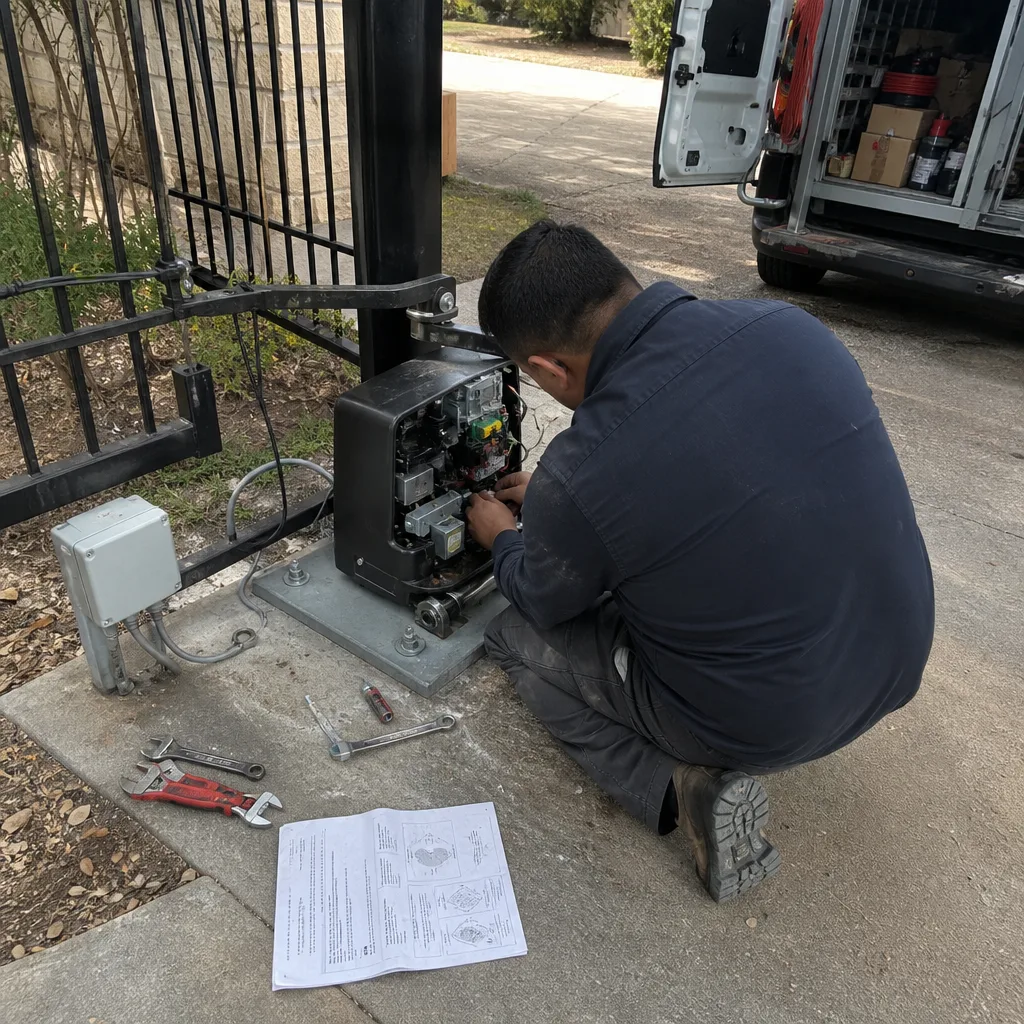
Free on-site gate assessment - hinges, posts, and your LiftMaster or Nice gate operator checked before anything is quoted
The assessment is free and the quote is the invoice.


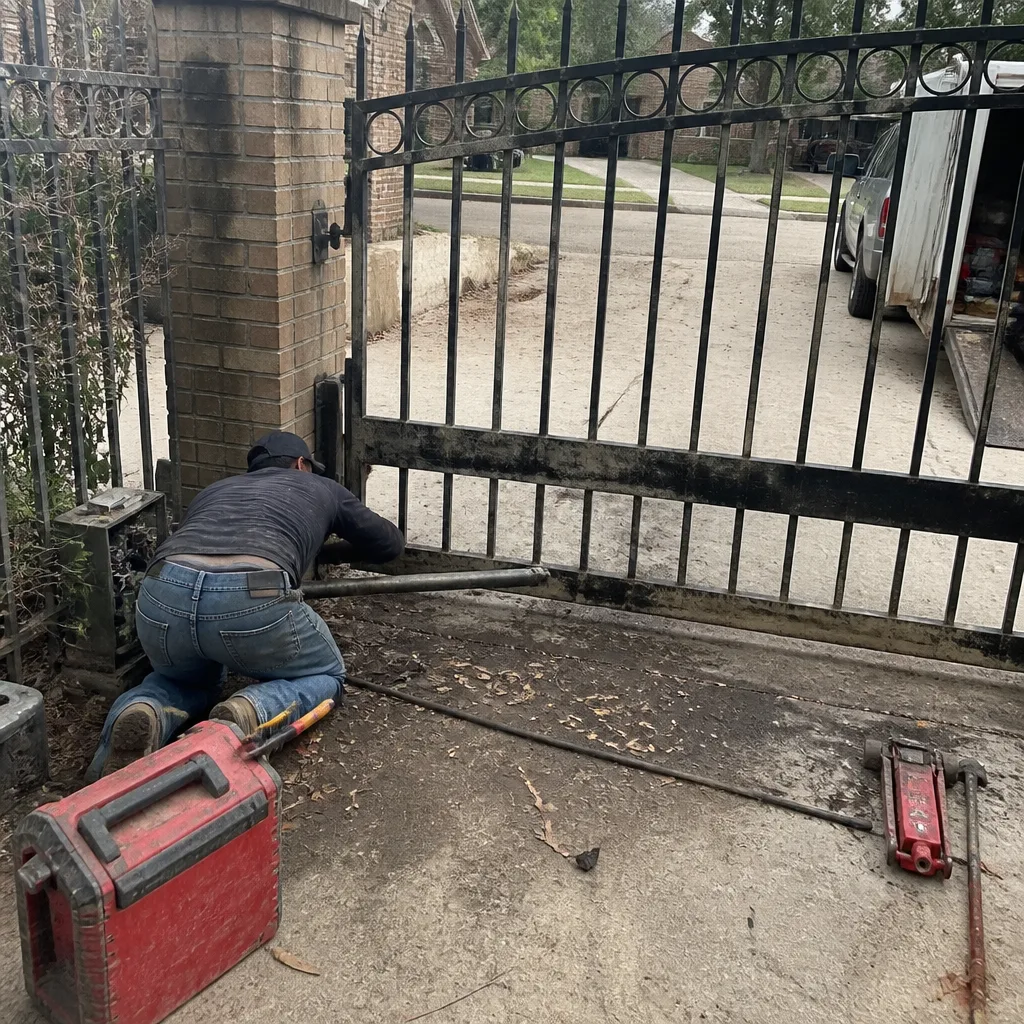 Before
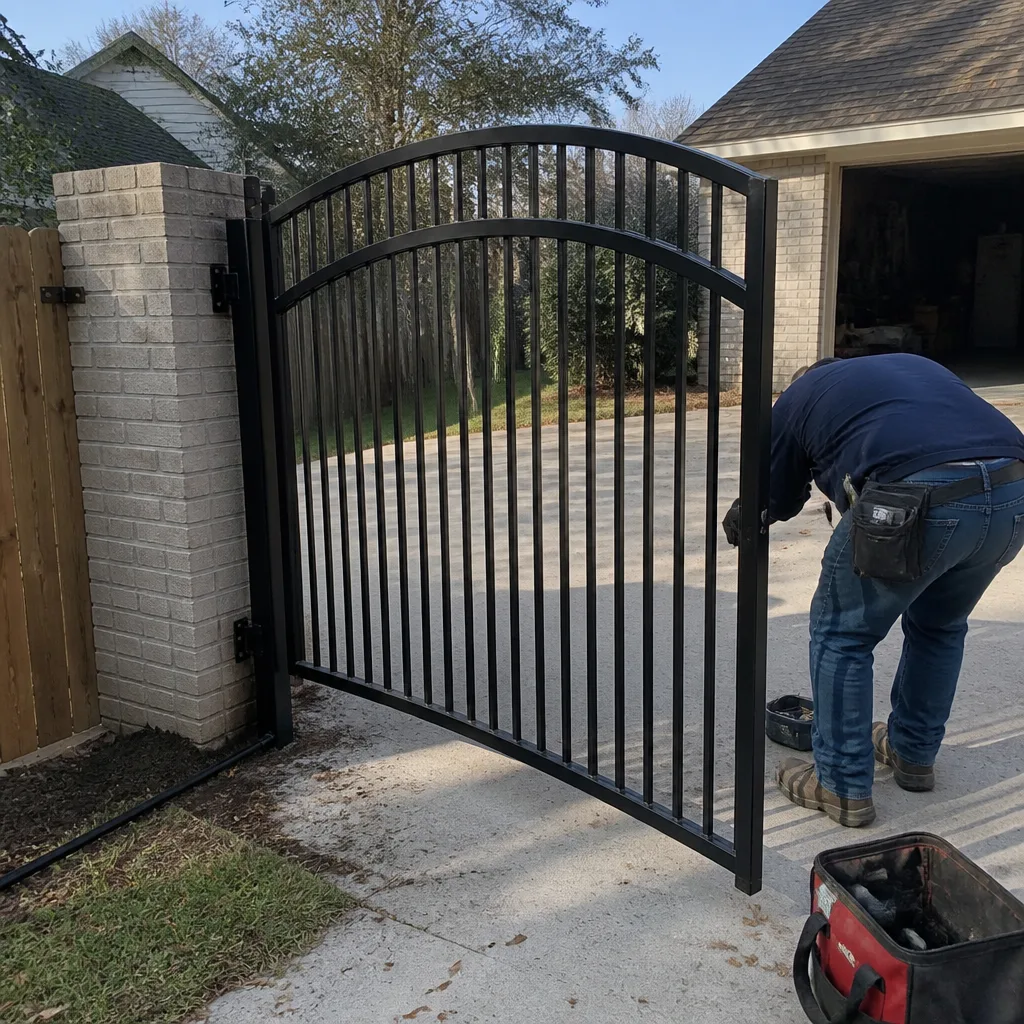 After
After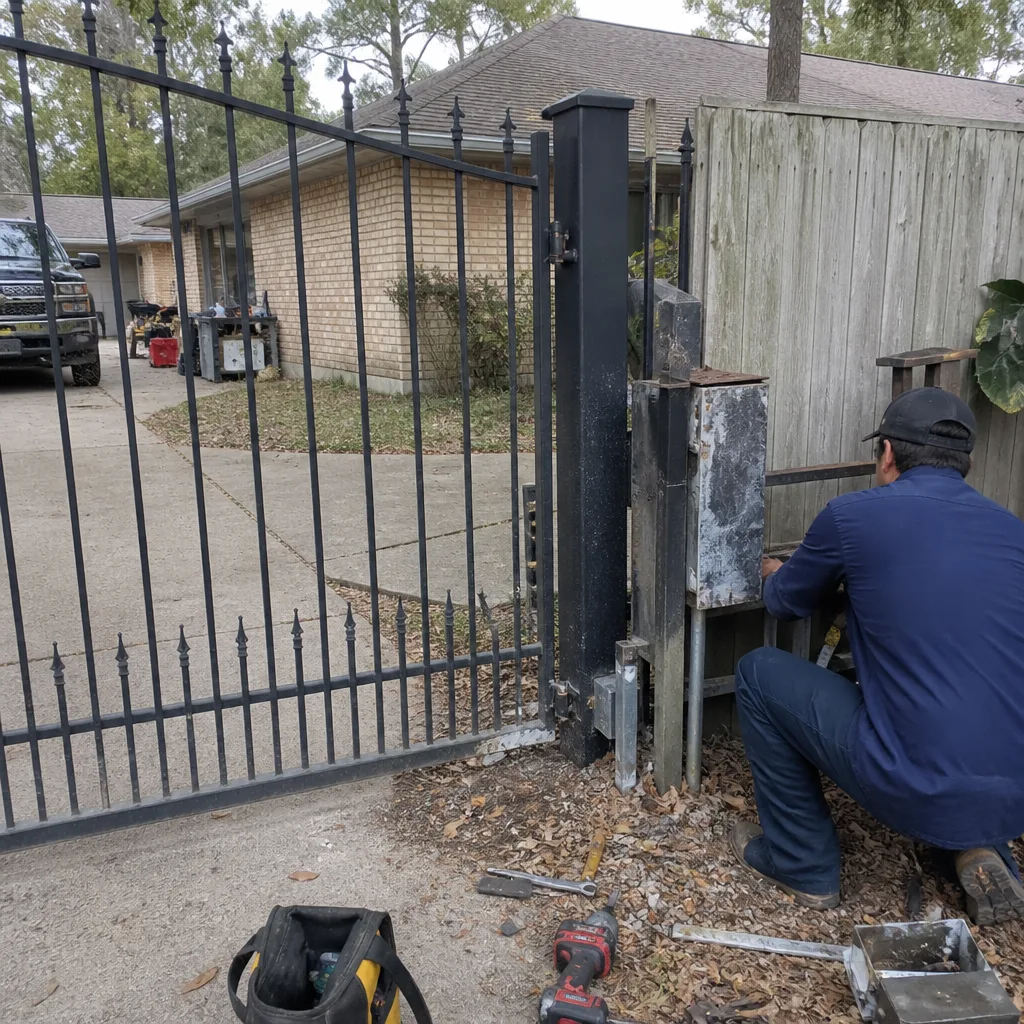 Before
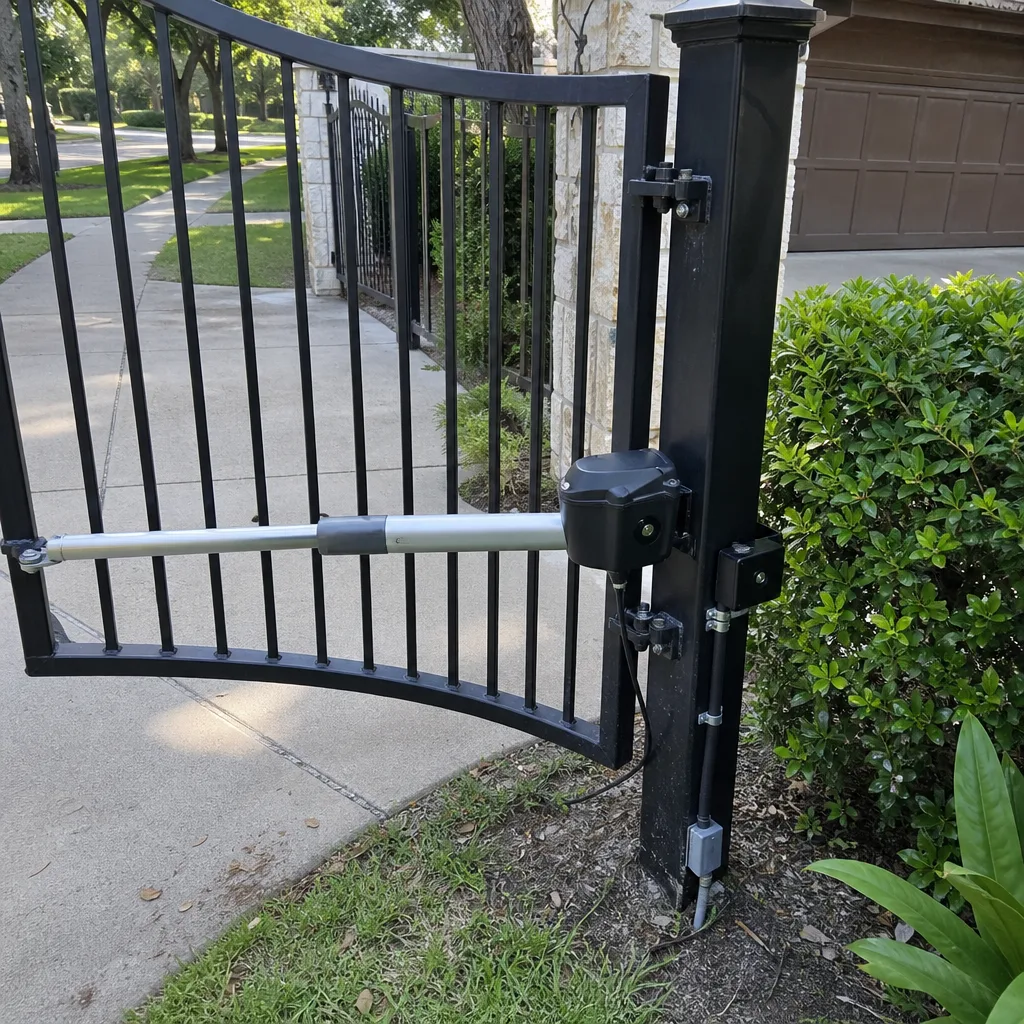 After
After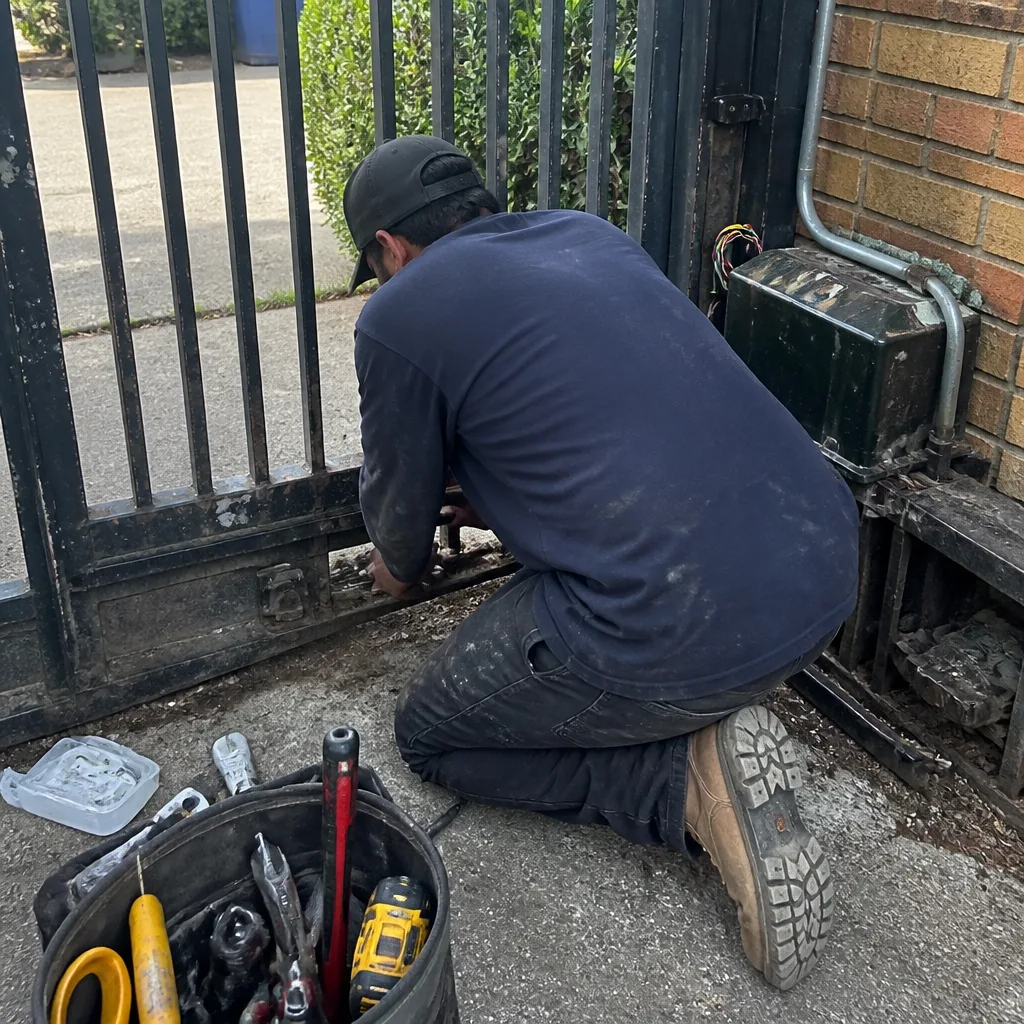 Before
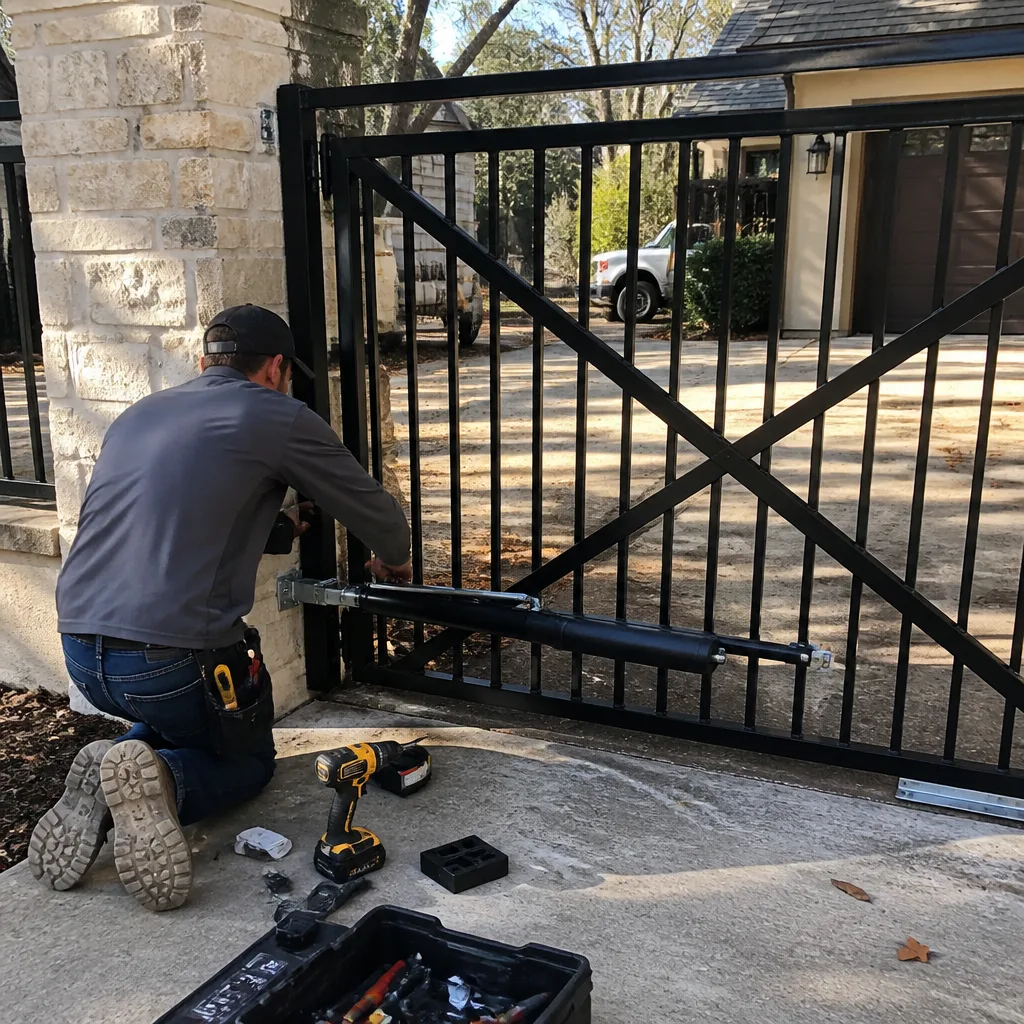 After
AfterGate Repair Warning Signs: A Spring Homeowner’s Reference Guide
A gate that hesitates for two seconds before moving is not “slowing down with age.” It is a gate that will fail to open during the next power fluctuation, which in Spring’s storm season could be tomorrow. This guide translates the subtle mechanical and electrical signals your gate is already sending into plain language, so you know whether to call a technician today or add the issue to next month’s list. We’ll cover the difference between sensor beeps and limit-switch stops, how to measure post lean with a level you already own, what rust location tells you about load-bearing risk, and the three sounds that mean stop using the gate immediately. By the end, you’ll be able to document warning signs in photos that show rate of progression, not just current condition. Homeowners across Spring deal with these same signals every month, and most of them are addressable before the gate quits entirely.
Quick Answer
Gate repair warning signs fall into three categories: motion problems (hesitation, jerky travel, stopping partway), sound problems (grinding, clunking, whining from the motor), and structural problems (visible post lean, rust at weld joints, sagging leafs). In Spring, where clay soil shifts with drought and flood cycles, post lean under 3 degrees is usually shimmable, but anything past that typically needs resetting within 90 days. If your gate beeps and reverses, check for obstruction first; if it moves partway and stops without beeping, the limit switch or torque cutoff is the likely culprit, and a technician should look at it. Most warning signs are cheaper to fix early than to address after a full failure, so consider scheduling Gate Repair services before the issue worsens, and a written price before work starts should be non-negotiable.
Table of Contents
- Motion Signals: Hesitation, Jerking, and Partial Travel
- Sound Signals: The Three Noises That Mean Stop Using the Gate
- Structural Signals: Post Lean, Rust Location, and Leaf Sag
- Electrical Signals: Beeps, Blinking Lights, and Partial Power
- How to Measure Post Plumb Yourself (and What the Number Means)
- Documenting Warning Signs in Photos So a Technician Can Assess Rate of Progression
- Spring-Specific Factors: Clay Soil, Storm Season, and Humidity
- Common Mistakes to Avoid
- When to Call a Professional
- Frequently Asked Questions
- The Bottom Line
BeforeAfterMotion Signals: Hesitation, Jerking, and Partial Travel
Most gate failures begin as motion irregularities that are easy to dismiss. A gate that pauses before moving, shudders halfway through its travel, or stops at inconsistent positions is reporting a problem in measurable terms. The two-second hesitation you noticed this morning is not the motor “warming up.” It is usually the capacitor struggling to deliver starting torque, a limit switch losing its setting, or a battery backup that is no longer holding a charge under load.
In our experience across Gate Repair in Spring, the most common motion complaint we document is a swing gate that slows noticeably in the last foot of travel and then stops two inches short of the closed position. Homeowners assume the arm is worn. What we usually find is a torque cutoff set too low at installation, compounded by a year of soil movement that shifted the post just enough to change the geometry. The fix is often a torque adjustment and a re-set of the close limit, not a new motor.
Here is how to categorize what you are seeing:
- Hesitation before movement (1-3 seconds): Starting capacitor degradation, low battery in a solar or backup system, or a control board delay setting that has drifted. Addressable without motor replacement in most cases.
- Jerky or stuttering travel: Usually a gear train issue in the operator arm, a dry hinge point, or debris in the track. On slide gates, check the V-track for pebbles and the wheels for flat spots.
- Stops at inconsistent positions: A limit switch that is losing its mechanical or magnetic reference. This is the gate’s “memory” failing, and it will get worse. Reset and photograph the new position.
- Reverses mid-travel without obstruction: Safety loop or photo-eye signal intermittent, or a current-sense (obstruction detection) threshold set too tight. Do not disable the safety input to fix the symptom.
If your gate hesitates but still completes its travel, you have time to schedule service. If it stops partway and will not complete the cycle without a manual reset, call sooner. The distinction matters because a gate that fails at partial travel is also a gate that can pin a vehicle or a person if it fails at the wrong moment.
Sound Signals: The Three Noises That Mean Stop Using the Gate
Sound is the most reliable diagnostic tool a homeowner has, because it does not require any disassembly. Three specific sounds, when they appear together or alone, indicate a problem that should stop gate use until a technician can inspect it. These are not cosmetic noises.
- Grinding on open: This is metal-on-metal contact in the gear train or a failing bearing in the operator arm. It will not self-resolve. Continued use converts a gear tooth into metal shavings in the gearbox, which then takes out the next tooth and the next. We have opened operators in Spring where the gearbox oil looked like metallic paint because a mild grind ran for months.
- Clunk at end of travel: A single clunk when the gate reaches full open or full close usually means the limit switch is not stopping the motor before the mechanical stop does. The motor is hammering the end stop every cycle. This is a limit-switch adjustment, not a “normal” sound, and a 15-minute fix becomes a motor replacement if ignored.
- Intermittent high-pitched whine from the motor housing: This is often the capacitor or the transformer vibrating at a frequency that indicates it is failing under load. On linear-arm operators, it can also be the arm’s internal screw or belt tensioner. A whine that comes and goes with load changes is electrical; a constant whine is mechanical.
If you hear grinding, stop using the gate and switch it to manual mode if your operator has one. The manual release is usually a small lever or key on the operator housing. If you are not sure where it is, do not force the gate by hand against a running motor. Call a technician and describe the sound in detail, or consult our How to Hire a Gate Repair Contractor in Spring: A Step-by-Step Guide first. Record it on your phone if you can; a 10-second audio clip is more useful to us than any verbal description.
Structural Signals: Post Lean, Rust Location, and Leaf Sag
Structure fails slowly and then all at once. The good news is that structural failure leaves visible evidence for months before the gate drops. The two places to look are the posts and the weld joints.
Post lean: A gate post that is out of plumb changes the entire geometry of the installation. The hinge side carries the weight of the leaf; if that post leans even two degrees, the leaf loads the hinges unevenly and the latch no longer aligns. Post lean in Spring is often caused by clay soil expansion and contraction. The soil moves, the post moves with it, and the gate that closed perfectly in October binds by March.
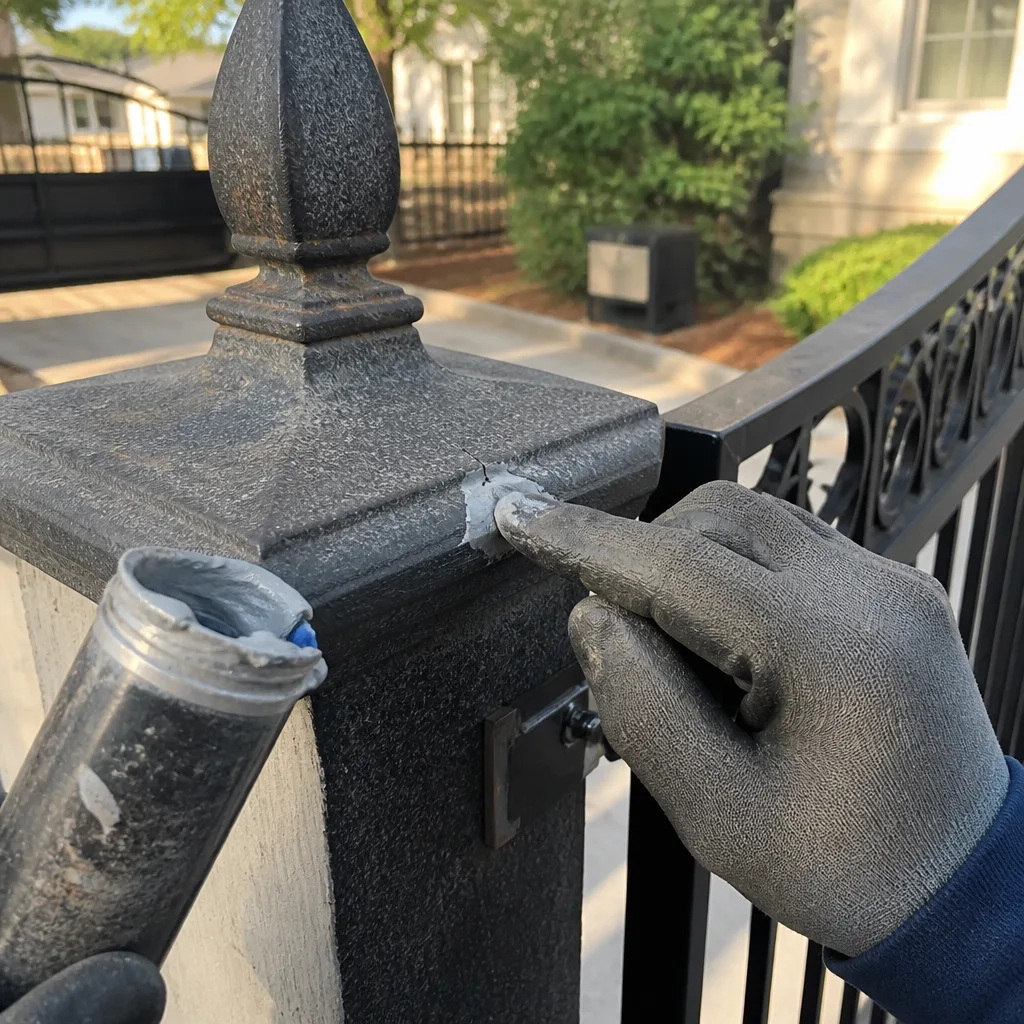
Rust location: Not all rust is equal. Surface rust on the rail or the face of the gate is cosmetic and can be wire-brushed and painted. Rust at weld joints is structural: the weld is the point of highest stress, and rust there means the connection is losing section thickness. Rust at hinge plates is also structural, because the hinge plate transfers the entire weight of the leaf to the post. If you see orange staining running down from a hinge plate, the plate or the post behind it is actively corroding. In Spring’s humidity, this progresses faster than homeowners expect.
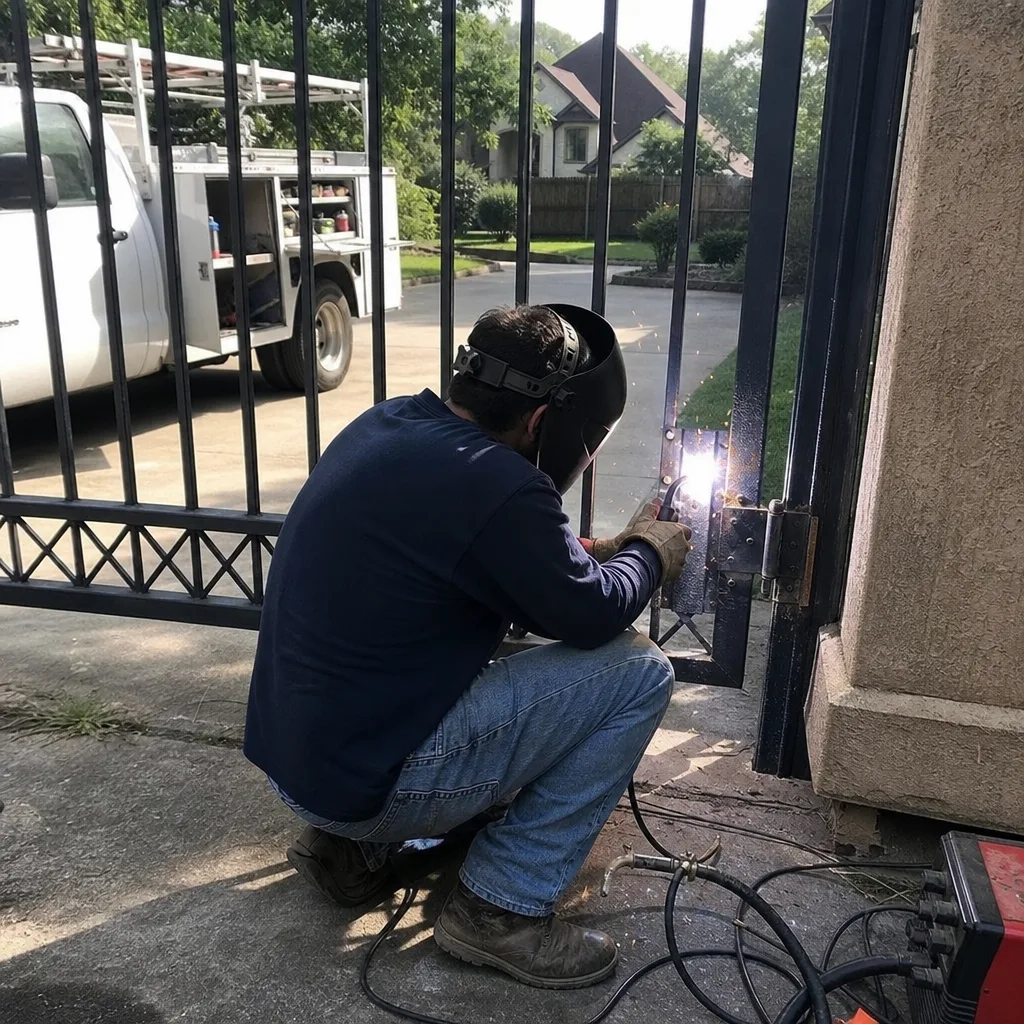
Leaf sag: A gate leaf that has dropped means the hinge side has moved or the hinge pins have worn. Measure it: gate leafs should have a consistent gap between the leaf and the ground across the full width of the opening. If the gap at the latch side is visibly smaller than the gap at the hinge side, the leaf has sagged. A welding repair or hinge replacement is in your future, and it is cheaper before the leaf starts dragging.
Electrical Signals: Beeps, Blinking Lights, and Partial Power
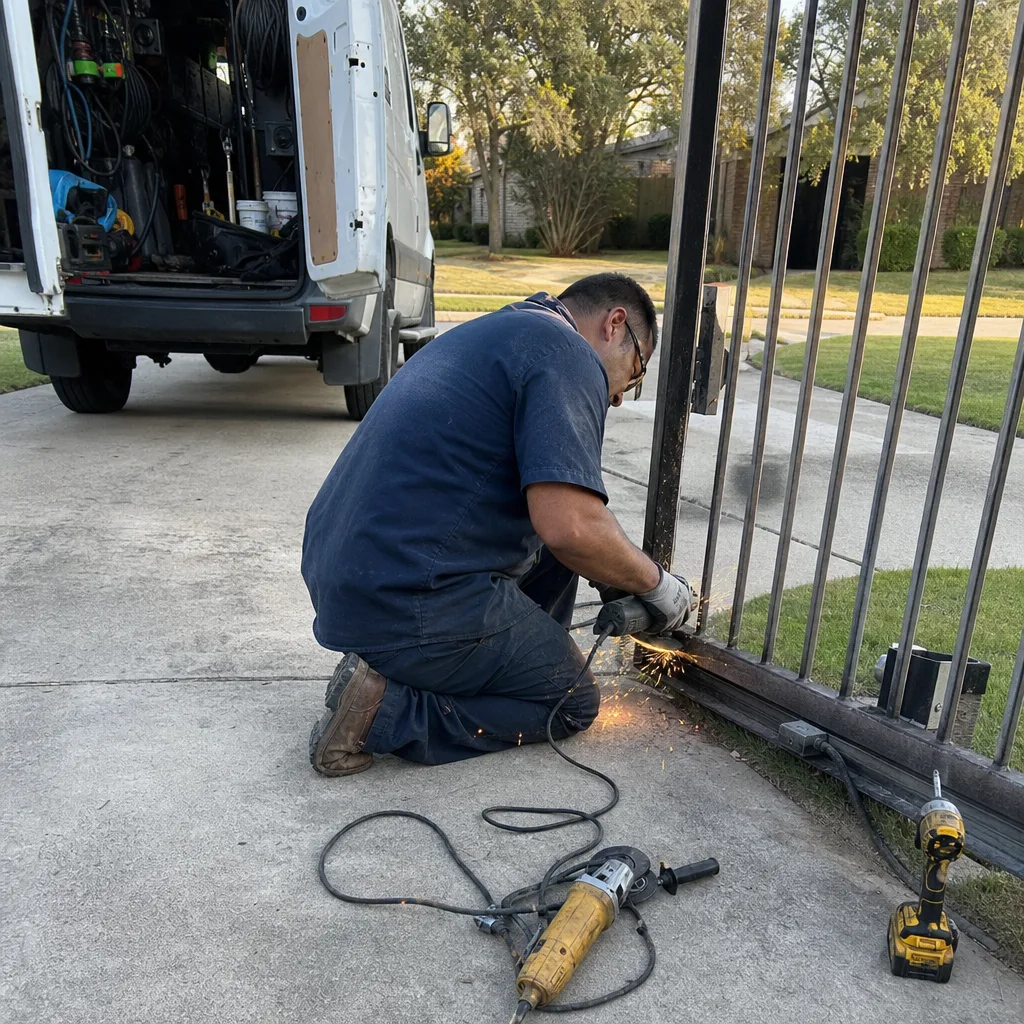
Automated gates speak in beeps and blinking codes, and most homeowners never learn the vocabulary. The most important distinction in gate electronics is between a safety reversal and a mechanical stop.
A gate that beeps and reverses is responding to a sensor input. The photo-eye, the safety loop, or the edge sensor is telling the control board that something is in the path. The gate is doing what it was designed to do. The problem is that the sensor is misaligned, dirty, or failing, and the gate is now seeing obstructions that are not there. A photo-eye (the infrared beam that stops the gate if something crosses the path) misaligned by two inches will cause exactly this. Clean the lens with a dry cloth and check that the two eyes are pointed directly at each other. If the reversal continues, call a technician; the sensor may need replacement or re-aiming.
A gate that moves partway and stops without beeping is different. This is a mechanical stop, usually from a limit switch reaching its set point early or a torque cutoff tripping. The gate is not saying “something is in the way”; it is saying “I think I am done.” This is a limit-switch adjustment or a torque re-set, and it is addressable the same day in most cases.
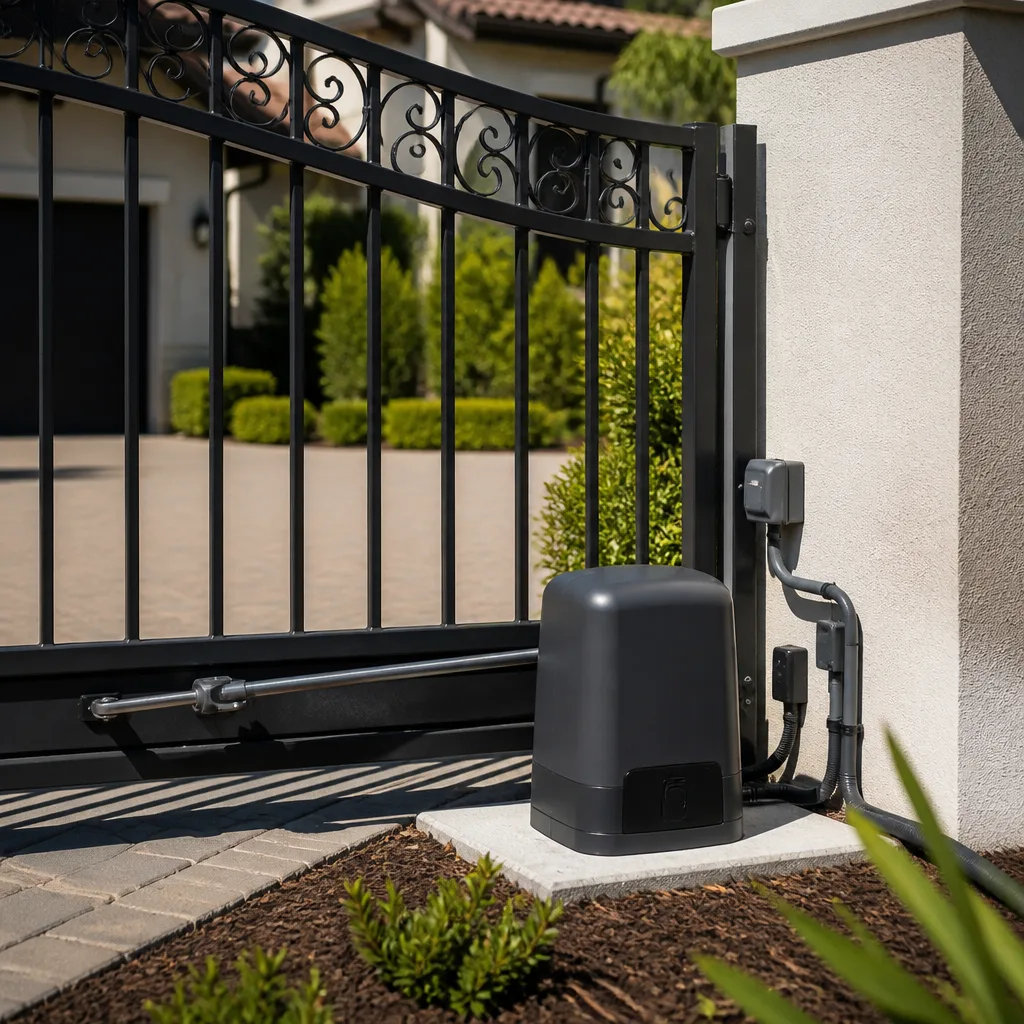
Blinking lights on the operator board are fault codes. Every brand has its own sequence: BFT boards use a series of LED flashes, Linear operators have a diagnostic port, and Viking boards display a numeric code. If your operator is blinking, do not reset it and hope. Note the pattern, photograph it, and describe it when you call. The code tells us what the board thinks is wrong, and clearing it erases the evidence.
How to Measure Post Plumb Yourself (and What the Number Means)
You can measure post lean with a level, a plumb bob, or a phone app. Here is the method we recommend, and it takes five minutes. This is not a DIY repair instruction; it is a diagnostic so you know whether to schedule service now or later.
- Place a 4-foot level vertically against the face of the gate post, on the side the gate is mounted to. If you do not have a 4-foot level, use a shorter one and measure the gap at the top and bottom.
- Record the gap at the top of the level. The gap is the distance between the level and the post face. If the post is plumb, the level touches the post along its full length.
- Measure the gap in inches, then convert to degrees. For a 4-foot level, every 1/16 inch of gap is roughly 0.1 degrees of lean. A 1-inch gap at the top of a 4-foot level is about 1.2 degrees.
- Apply these thresholds: Under 0.5 degrees, no action needed, monitor it seasonally. Between 0.5 and 3 degrees, schedule a post re-set or shim within 90 days; the gate will still operate but the hinge load is increasing. Over 3 degrees, this is a structural repair and the gate should not be relied on; the post footing has shifted and the gate is now levering against whatever remains of the footing’s integrity.
- Photograph the measurement. Place a tape measure across the gap at the top of the level and photograph the reading. A technician can use this to assess rate of progression between visits.
In Spring, we see post lean accelerate after long dry spells when clay soil contracts and pulls away from concrete footings. A post that was fine in April can be visibly out of plumb by August. If you are measuring post lean for the first time, write down the date and the gap. Repeat the measurement in three months. The rate of change matters more than the absolute number.
Documenting Warning Signs in Photos So a Technician Can Assess Rate of Progression
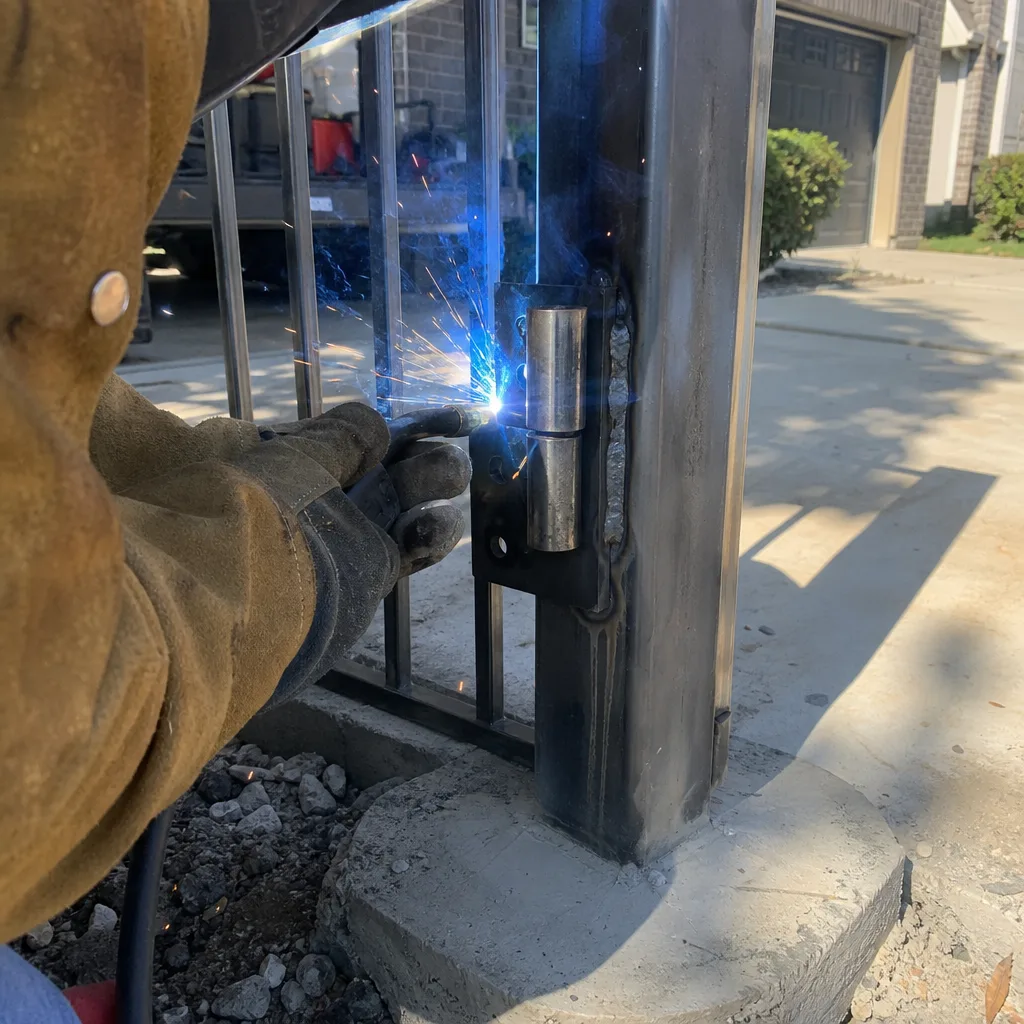
A single photo of a rusty hinge tells us something. Six photos taken a month apart tell us how fast the problem is moving. Rate of progression is the single most useful piece of information a homeowner can bring to a gate repair conversation, and it costs nothing to collect.
Here is the documentation protocol we recommend for any gate warning sign:
- Use the same camera position every time. Stand in the same spot, hold the phone at the same height. Consistent framing lets us compare images directly.
- Include a reference object. A coin, a key, or a tape measure in the frame gives scale. A rust patch the size of a quarter means something; a rust patch without a reference means nothing.
- Photograph at the same time of day if possible. Shadows change how a crack or a gap looks. Consistency helps.
- Label the file with the date and the symptom. Your phone does this automatically with metadata, but a quick rename like “hinge-rust-March-15” saves everyone time.
- Take a short video of motion problems. A 10-second clip of the gate hesitating is more diagnostic than a written description, because we can hear the motor, see the travel speed, and count the delay.
When we dispatch a technician to a Gate Installation in Spring or repair job, the first thing we ask for is any photo or video the homeowner has collected. It shortens the diagnostic time and it means we arrive with the right parts on the truck the first time. Under the Haven Standard, every visit also includes our own documented photo record: what we found, what we adjusted, and what we installed, left with the homeowner and filed in the job record. You should never be in a position where two companies look at the same gate and you have to describe the symptom from memory.
Spring-Specific Factors: Clay Soil, Storm Season, and Humidity
The warning signs described in this guide do not change by region, but the rate of progression does, as explained in our Seasonal Gate Repair Care for Spring: Year-Round Homeowner’s Guide. Spring sits on expansive clay soil that swells when wet and contracts when dry. That seasonal movement acts on gate posts, concrete footings, and underground conduit in ways that accelerated everything on this list.
Clay soil and post lean: When clay soil dries, it shrinks away from concrete footings and the footing loses lateral support. The post leans. When the rains return, the soil swells and does not always return to the same position. The result is incremental post movement that many homeowners attribute to “settling” but is actually a repeating cycle of movement and partial recovery. This is why we say post lean over 3 degrees should be addressed within 90 days in Spring: the next wet-dry cycle will add another half degree, and the cumulative effect compounds.
Storm season and power interruptions: Spring’s storm season brings power fluctuations. A gate with a failing capacitor or a worn starting circuit will run fine on stable power and fail to start on the first brownout of the season. If your gate hesitated even once during the last storm, the problem is not the storm. The storm exposed a component that was already failing. The gate that will not open after a power outage usually has a battery backup that has not been holding a charge for months, and the outage simply revealed it.
Humidity and corrosion: Spring’s average humidity accelerates corrosion at every unprotected metal surface. Rust at weld joints moves faster here than in drier climates. A homeowner who notices early rust staining at a hinge plate in March and does nothing will likely have significant section loss by October. The fix is wire-brushing, treating, and repainting, or replacing the hinge plate if the section is compromised. It is a $150 to $400 repair if caught early and a $1,200 to $2,500 weld-and-rehang job if the plate or the post fails.
Common Mistakes to Avoid
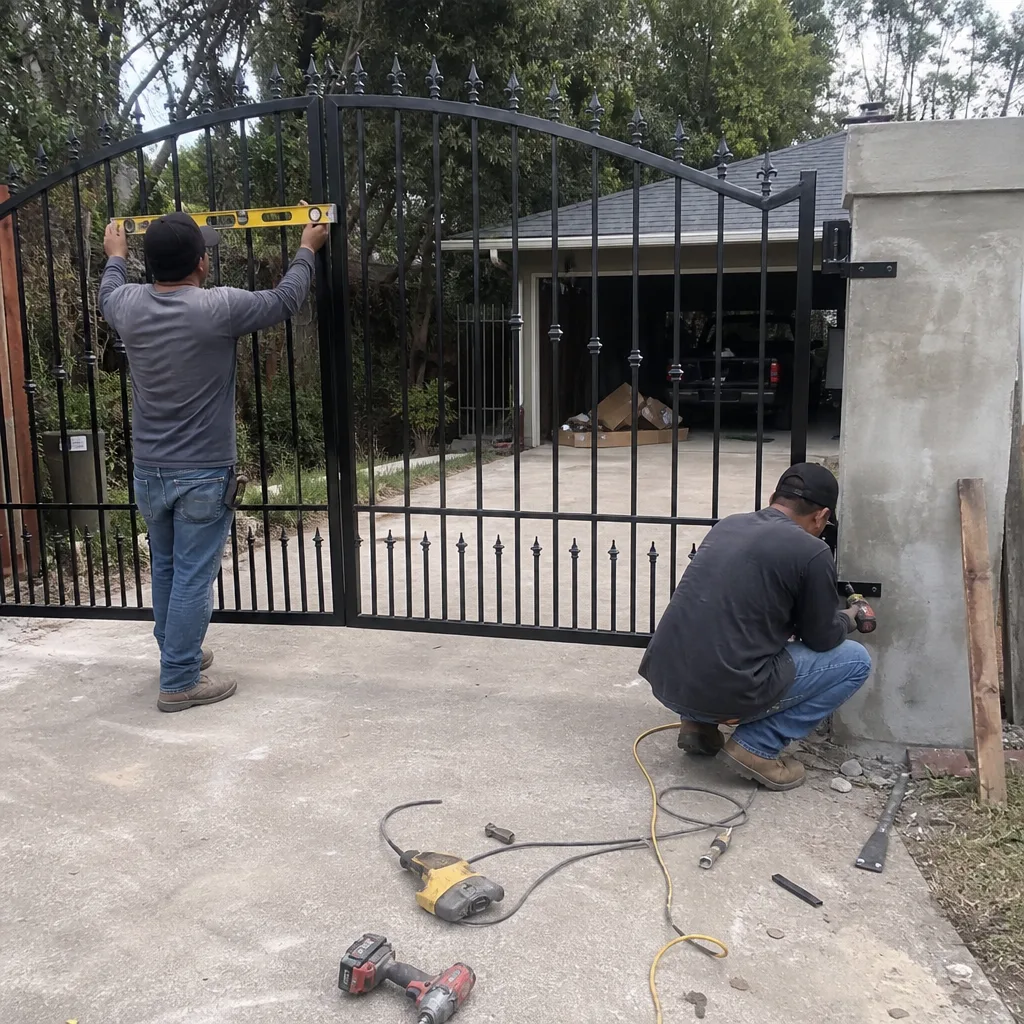
- Resetting the breaker and hoping. If a gate tripped a breaker, the breaker did its job. Resetting it without finding the cause is how you turn a short into a fire. Find the fault first.
- Disabling the safety sensors. A gate that beeps and reverses is working correctly. Disabling the photo-eye or safety loop to “fix” the reversal removes the one system standing between the gate and a pinned child or pet.
- Spraying lubricant on everything that moves. WD-40 on a gear train attracts dust and creates a grinding paste. Lubricate only what the manufacturer’s manual says to lubricate, and use the specified product.
- Assuming the gate is old so the problem is normal. Gates do not “slow down with age” as a maintenance-free condition. A slowing gate is a gate with a specific, addressable problem. “It has always done that” is the most expensive sentence in gate repair.
- Calling after the gate fails completely. The warning signs in this guide were visible for weeks or months before the failure. A gate that stops working during a storm is usually a gate that reported its problem through hesitation, noise, or reversal long before the storm hit.
- Accepting a verbal estimate. A verbal quote is not a quote. Get the scope, the price, and the parts in writing before work begins. This is non-negotiable, and it is the entire point of the Haven Standard’s Clause 1.
When to Call a Professional
Call a gate technician if you hear grinding, if the gate moves partway and stops without beeping, if your post measures more than 3 degrees out of plumb, or if you see rust at weld joints or hinge plates. Call immediately if the gate reverses unpredictably, because a safety system that misfires is a liability. Call if you have reset a breaker more than once. If you have documented warning signs in photos, bring them to the conversation. A technician who can see a month-over-month change can often diagnose the problem without a second site visit.
Vance Gate Repair Spring offers free estimates in Spring, and the price is delivered in writing before any work begins. Call (346) 488-1637 and describe the symptom. A live person answers at any hour.
Frequently Asked Questions
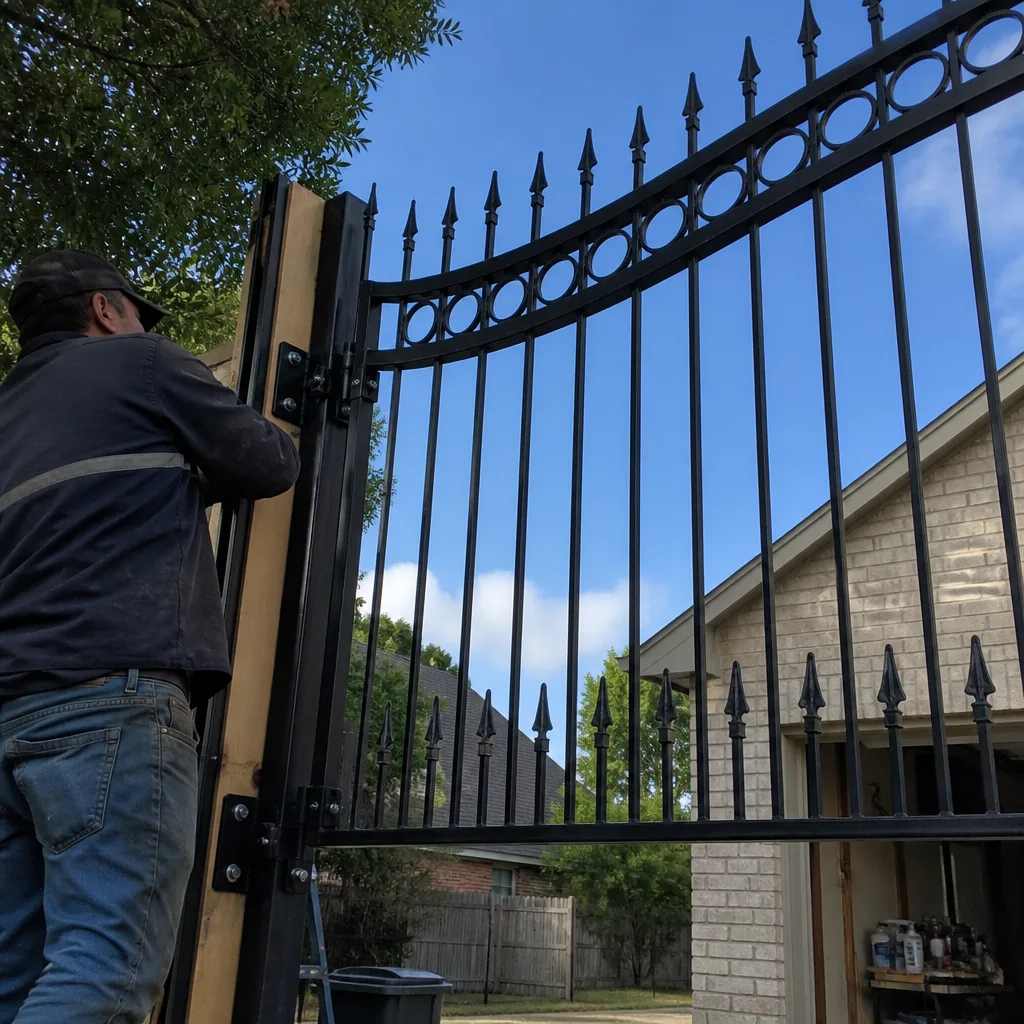
Yes, but it is usually a sensor issue, not a motor issue. The photo-eye is misaligned, dirty, or failing, and the gate is doing its job by refusing to close on what it thinks is an obstruction. Clean the lens and check alignment first; if the reversal continues, call a technician. Call (346) 488-1637 for a diagnostic visit, and we will quote the repair in writing before any work starts.
Most gate repairs in Spring run between $150 and $600, depending on the component. A limit-switch adjustment or photo-eye re-aim is typically $150 to $300. A capacitor, control board, or safety sensor replacement is usually $300 to $600. A post re-set or weld repair starts around $500 and goes up based on access and footing condition. The exact price is written and handed to you before any work begins.
For urgent repairs, yes. A gate that will not close, grinds loudly, or behaves unpredictably is a same-day dispatch. Call (346) 488-1637 and tell us what the gate is doing; a live person answers around the clock. For non-urgent items like a photo-eye re-aim or a scheduled post re-set, we will set the next available slot.
The limit switch tells the motor where the gate’s travel ends. When it fails or drifts, the gate stops partway or hammers the end stop on every cycle. It is a small component with an outsized effect. We reset limit switches on every Gate Motor & Opener in Spring service call and photograph the new position so the setting is documented.
We service nine major automation brands including BFT, Linear, Viking, and Ghost Controls, plus LiftMaster, FAAC, DoorKing, Elite, and Mighty Mule. The brand does not matter as much as the condition of the installation. We diagnose and repair what is on the property rather than steering toward a replacement.
Photograph the gate in its failed position, the operator housing with any blinking lights visible, the post base where it meets the concrete, and any rust or cracks you have noticed. If you have older photos of the same area, dig those up too. Rate of progression is diagnostic gold. For more guides & resources, see the section above on documenting warning signs.
For a free estimate on any gate issue, call (346) 488-1637. We quote in writing before we touch the gate.
The Bottom Line
Gates announce their failures in measurable signals: hesitation, partial travel, specific sounds, post lean, rust location, and blinking fault codes. The distinction between a sensor reversal and a limit-switch stop tells you whether you have a safety input issue or a mechanical setting issue. Post lean under 3 degrees is manageable; over 3 degrees is a structural repair and should be scheduled sooner than later in Spring’s clay soil. Document everything in photos, because rate of progression is the most useful diagnostic information a homeowner can provide. And never accept a verbal estimate for work on a gate: the price should be in writing before the first tool comes off the truck. If your gate is showing any of the warning signs in this guide, call (346) 488-1637 and we will tell you what we think it is and what it costs to fix, in writing, before any work begins.
For more on what we do and how we price it, start at the Vance Gate Repair Spring home page.
Written by Adrian Vance, Owner at Vance Gate Repair Spring, serving Spring since 2014.