
Last updated September 20, 2026
Free on-site gate assessment - hinges, posts, and your LiftMaster or Nice gate operator checked before anything is quoted
The assessment is free and the quote is the invoice.


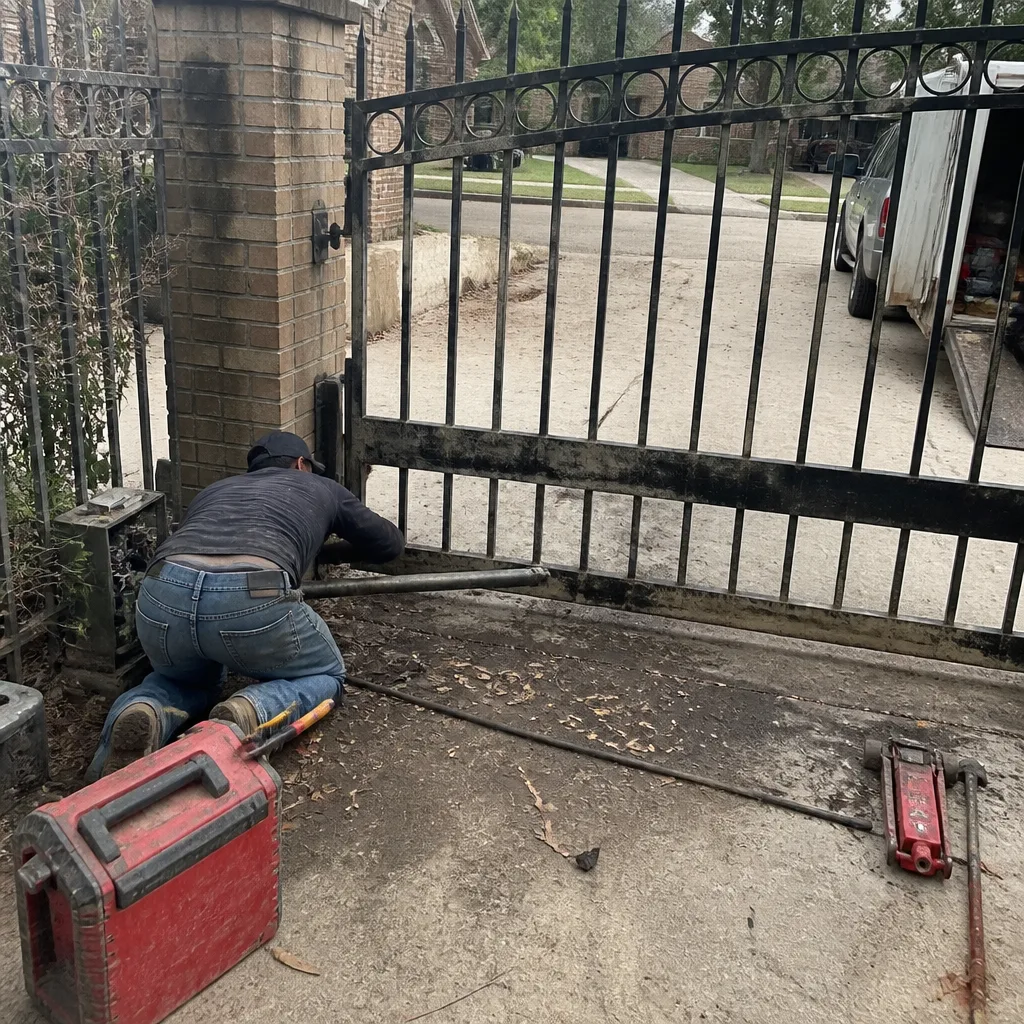 Before
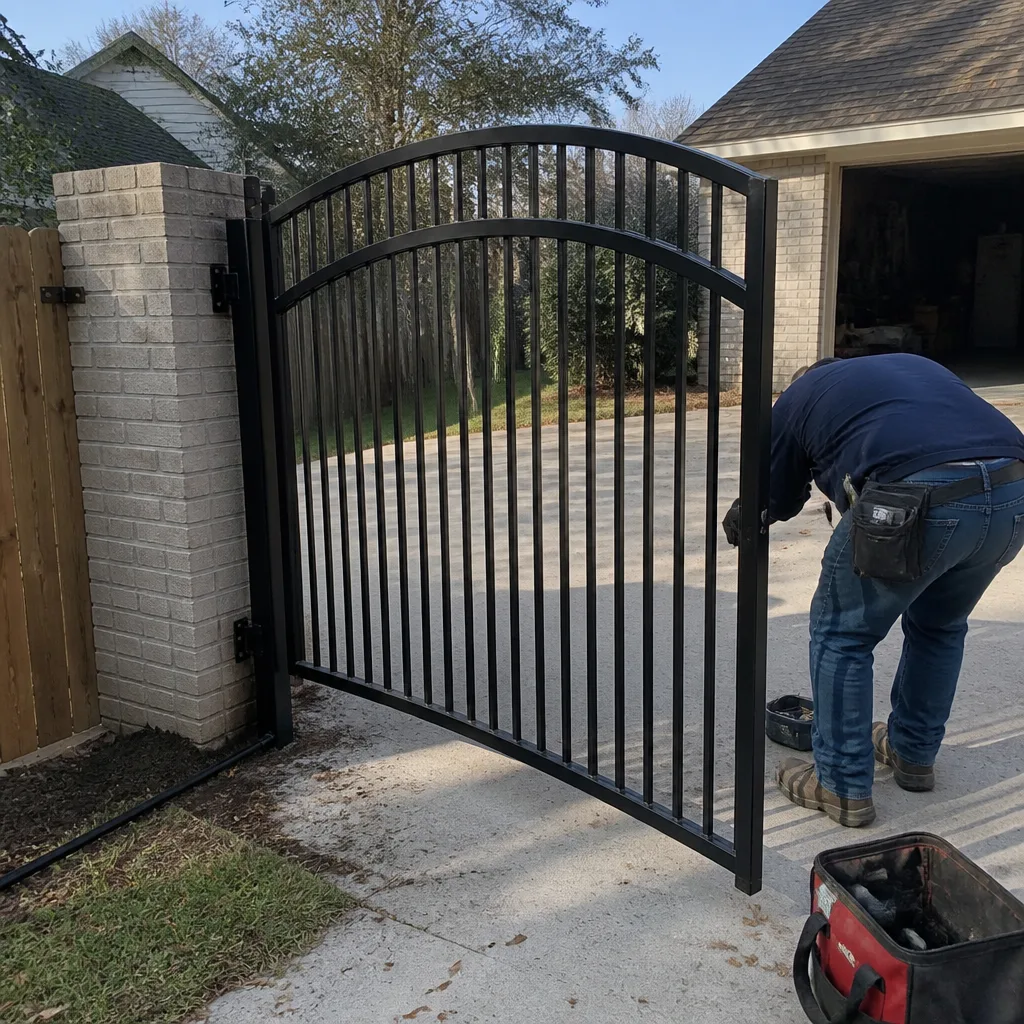 After
After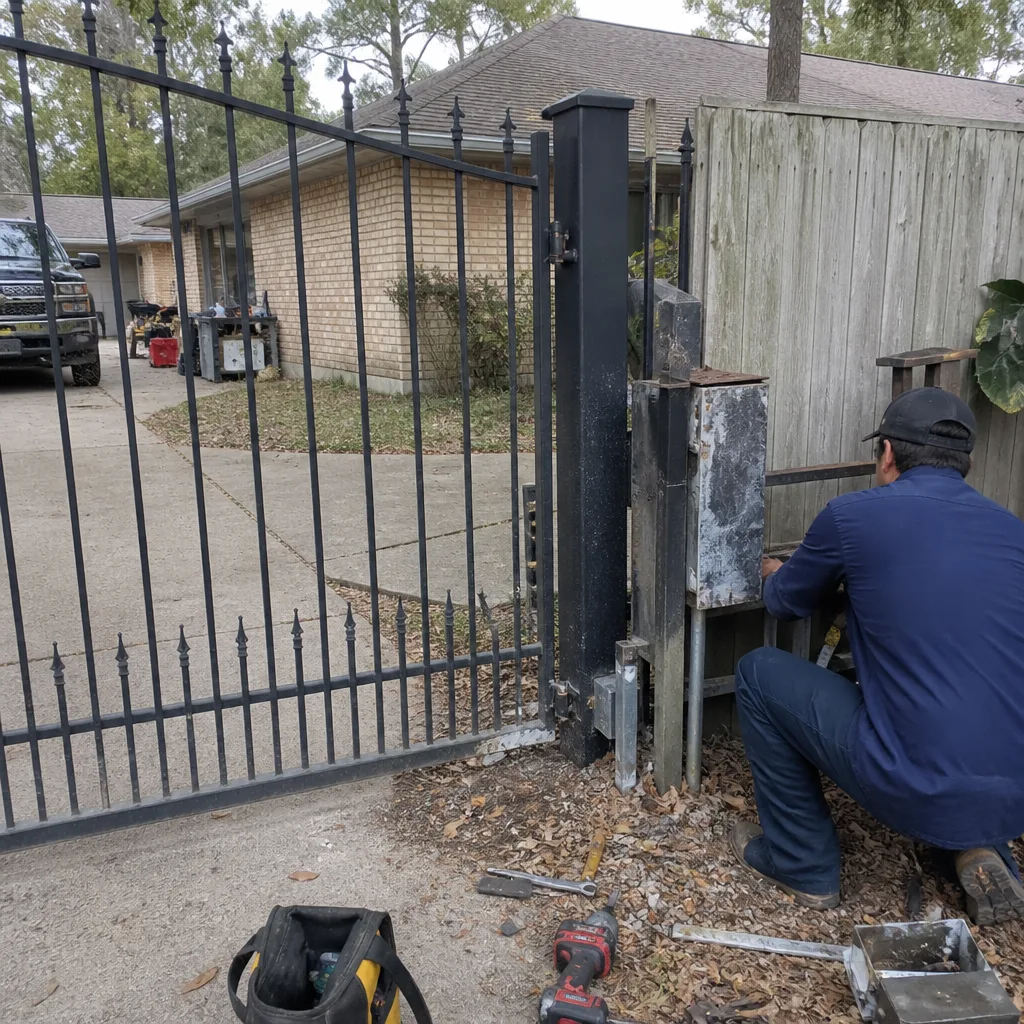 Before
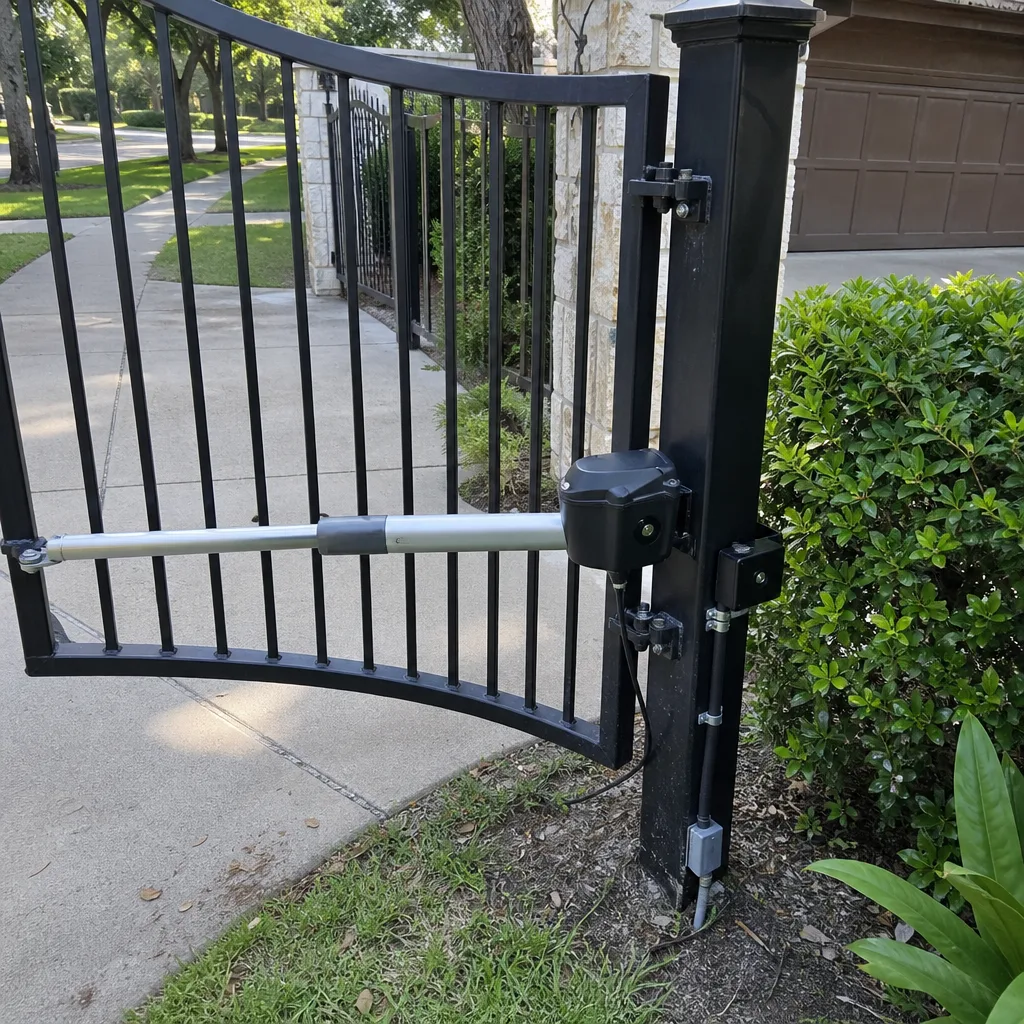 After
After Before
 After
AfterSeasonal Gate Repair Care for Spring: Year-Round Homeowner’s Guide
Most homeowners in Spring assume their gate fails because of wind, rain, or a lightning strike. Our repair records tell a different story. The single most common time for a gate motor board to fail in Spring is not during a storm. It’s about three weeks after, when residual moisture trapped inside an unsealed enclosure finally shorts a relay during a routine open cycle. By the time the gate stops responding, the storm is a distant memory and the homeowner can’t figure out what changed. This guide explains how Spring’s actual weather pattern, not a generic four-season calendar, dictates what to check on your gate and when to check it. You’ll learn which maintenance tasks matter in which months, what to inspect after a storm, what the cold snaps do to hydraulics, and which single task Spring’s pollen makes monthly instead of annual.
Quick Answer
Seasonal gate care in Spring, TX means adjusting your maintenance calendar to match the local climate: pre-summer thermal checks in March and April, storm inspections within 48 hours of any severe weather from May through September, and cold-snap preparation before the rare winter freezes. The most important year-round habit is photographing your gate’s condition after every major weather event so you have a documented timeline if a claim or repair dispute ever comes up.
Table of Contents
- The Spring Climate Problem: Three Phases, Not Four Seasons
- Pre-Summer Checklist: March Through April
- Storm Season Protocol: May Through September
- The Post-Storm Documentation Habit
- The One Monthly Task: Photo-Eye Lenses in Pollen Season
- Cold-Snap Preparation: December Through February
- Common Mistakes to Avoid
- When to Call a Professional
- Frequently Asked Questions
- The Bottom Line
BeforeAfterThe Spring Climate Problem: Three Phases, Not Four Seasons
General gate-care advice written for national audiences assumes the reader lives somewhere with a recognisable autumn and a real winter. Spring, TX doesn’t work that way. What we actually get is one long heat season that runs roughly from late May through September, a severe-weather shoulder on either side of it in spring and fall, and a short mild window in between, usually from mid-October through November and again in late February through early March. Each phase produces a different failure mode, and each failure mode responds to a different inspection priority. That’s why a calendar-based checklist beats a generic “check your gate twice a year” approach.
Here’s the pattern we’ve observed across thousands of gate repairs in and around Spring:
- Heat season (late May through September): thermal expansion stresses hinge welds, warps gate frames slightly, and pushes motor duty cycles harder. Capacitors degrade faster in sustained heat. Photo-eye lenses get coated with pollen dust and baked-on debris.
- Storm shoulder (April through May, and September through October): high winds, lightning, and heavy rain. Water intrusion into control enclosures is the big one. Lightning-induced surges kill circuit boards, even when the strike is not a direct hit on the gate.
- Mild window (mid-October through November, late February through early March): the best time for non-urgent maintenance. Temperatures are moderate, the ground is stable, and the pollen load is at its annual low. If you’re going to schedule a tune-up, this is when it will do the most good.
Understanding this pattern changes how you treat the gate. A hinge that squeaks in March is not the same problem as a hinge that binds in August. A motor that hums but doesn’t move in January after a freeze is not necessarily a dead motor. We’ll walk through each phase in order, starting with the pre-summer window, because that’s the one most homeowners in Spring skip entirely.
Pre-Summer Checklist: March Through April
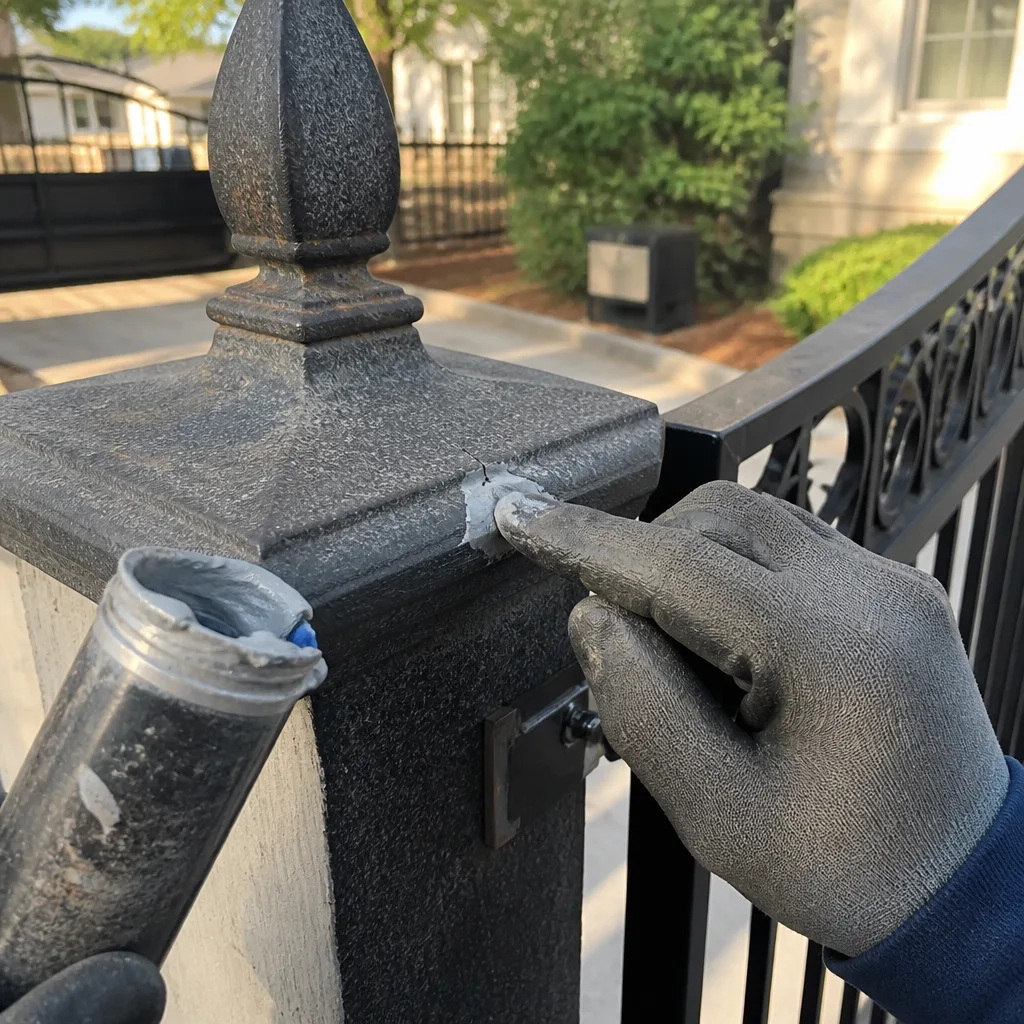
The mild window before the heat arrives is the most underused maintenance period in Spring. The goal here is simple: catch thermal stress before thermal stress catches you. When temperatures climb past 95 degrees, steel expands. A gate that opens cleanly at 78 degrees can bind at 98 degrees if the hinge gap is too tight. Once the gate binds, the motor strains against the extra friction. That strain shortens motor life and can trip limit switches, leaving the gate stuck half-open on the hottest day of the year. This pre-summer season is also a good time to assess whether your gate needs broader attention; our Gate Repair in Spring page outlines what a full inspection covers if you’d rather have a technician handle it.
Here is the pre-summer checklist we recommend, in order of priority:
- Measure the hinge gap. On a swing gate, the gap between the gate leaf and the post should be consistent along the full height of the hinge. On a slide gate, check the clearance between the gate and the track or roller guides. If the gap has closed since last year, the gate has shifted. A gap that tightens as the temperature rises is a binding event waiting to happen. We’ve measured hinge gaps in Spring that tightened by nearly a quarter inch between March and August.
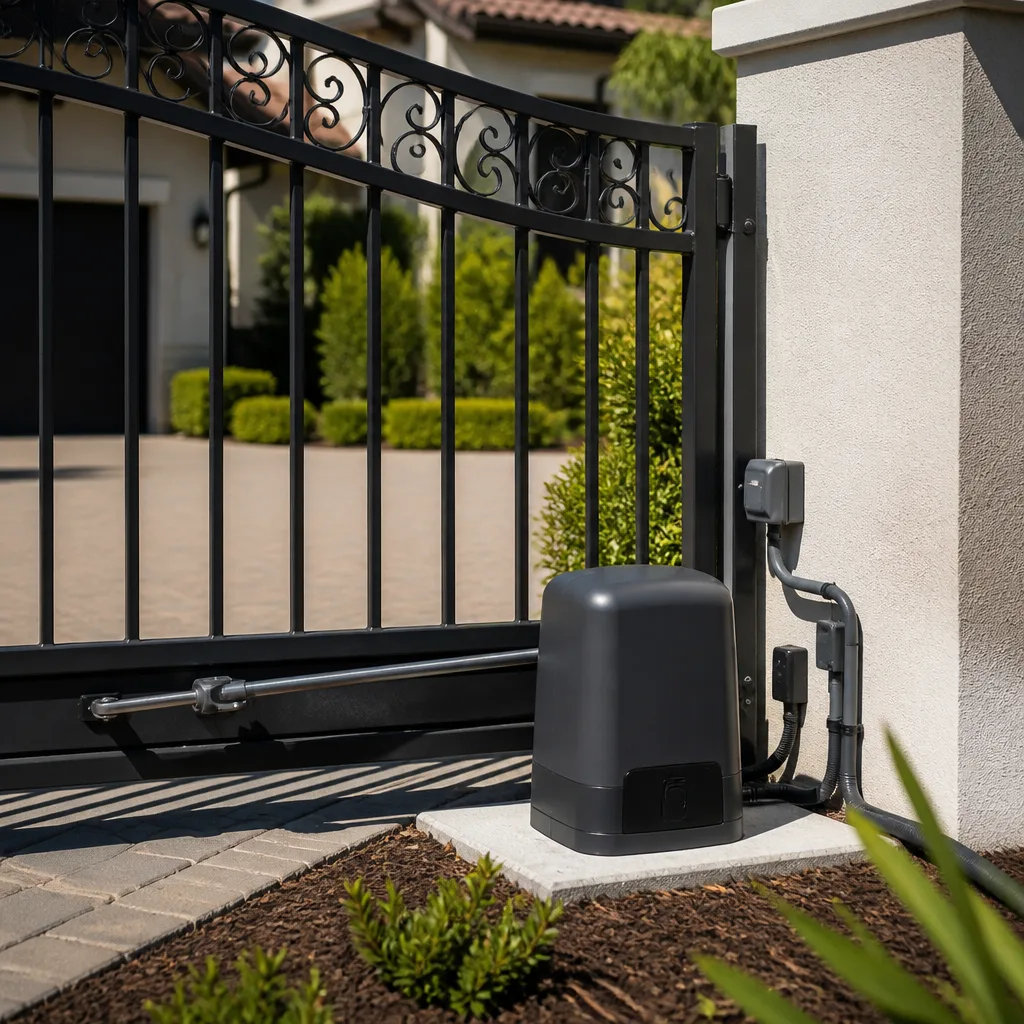
- Inspect the control enclosure seal. The gasket around the control box door is the only thing keeping humid Gulf air away from relays, terminals, and the circuit board. Run your finger along the gasket. If it’s cracked, flattened, or pulling away from the corners, it’s no longer sealing. Replacement gasket material is inexpensive. A shorted relay from condensation is not.
- Check limit switch travel. The limit switch tells the motor where to stop. Thermal expansion can change where “open” and “closed” actually land. If the gate was adjusted in cooler weather, it may over-travel or under-travel in summer. An under-traveling gate leaves a gap. An over-traveling gate slams into the stop, and repeated slamming breaks things.
- Clean the gear rack or chain. Grit and dust collect in the teeth of the rack or the links of the chain. When the temperatures rise, that grit bakes into a paste. Clean it out with a stiff brush and relubricate with a dry lubricant. Wet lubricants attract dust and make the problem worse.
- Test the battery backup (if equipped). Heat degrades battery chemistry faster than cold. If your gate opener has a battery backup, test it in April, not in September after it’s been cooking all summer. Most battery backups have a test function. If the gate won’t complete a full open-close cycle on battery power, the battery is weak.
The pre-summer window in Spring is also the right time to schedule any gate work you’ve been putting off. If your gate needs Gate Installation in Spring, doing it before the heat means the concrete sets properly and the technician isn’t working around afternoon thunderstorms. If you’re not sure whether your motor is healthy enough for another Texas summer, a Gate Motor & Opener in Spring evaluation now is cheaper than an emergency replacement in July.
Why Most Spring Homeowners Skip This
The honest answer: a gate that works feels like a gate that’s fine. Nothing in March forces you to look at it. The gate opens, the gate closes, and the hinge gap that’s half a millimeter tighter than last year doesn’t announce itself. By the time it announces itself, in the form of a burning smell or a tripped breaker in August, the repair is more expensive and the heat makes the job take longer. The pre-summer check costs an afternoon and a $10 tube of lubricant. The failure it prevents costs four figures.
Storm Season Protocol: May Through September
Storm season in Spring runs long. From roughly May through September, the afternoon thunderstorm is a regular event, and the bigger systems rolling in from the Gulf bring lightning, wind, and rain in volumes that test every outdoor electrical component on the property. A gate is uniquely exposed: it’s a large metal object, mounted on posts set into the ground, wired to a control board, and often positioned at the highest point of the driveway. All of that combines to make it a lightning-adjacent failure magnet.
Here’s what we look for on any gate that has been through a Spring storm:
- Lightning damage to the control board. A direct strike is obvious: scorch marks, melted terminals, dead board. But the more common failure is induced surge. A strike within a quarter mile of the property sends a voltage spike through the power lines and into the gate’s transformer. The board may not fail immediately. It fails three weeks later when a damaged relay finally gives out mid-cycle. If lightning struck within a quarter mile of your gate, assume the board has been stressed even if the gate still works.
- Water intrusion in the control box. Wind-driven rain can get past a seal that looks fine from the outside. Inside the box, you’ll see condensation droplets, water staining on the wiring, or corrosion starting on the terminal screws. This is the residual moisture that eventually shorts a relay.
- Debris blocking the photo-eyes. Storm wind throws leaves, branches, and dirt into the beam path. The gate will refuse to close, or reverse mid-close, because the beam can’t see through the debris.
- Track and roller damage on slide gates. Small branches and gravel washed into the track cause binding. The motor strains, the limit switch trips, and the gate stops moving. Clear the track and rollers before testing the motor repeatedly.
- Wind-load stress on the hinges and post. A large swing gate in high wind acts like a sail. The wind load flexes the hinges and, over repeated storms, starts to work the post loose in its concrete footing. A loose post shows up as a gate that sags or scrapes the ground where it didn’t before.
The 48-hour rule matters. Damage from water intrusion or surge stress gets worse every day it’s ignored. A corroding terminal that’s caught 48 hours after a storm is a cleaning job. The same terminal caught three weeks later is a replacement, and possibly a new board.
Storm Inspection Steps, In Order
- Disconnect power before opening the control enclosure. Moisture inside makes the box itself potentially live if there’s a short. This is a genuine electrocution hazard, not a precaution. If you’re not comfortable working around line voltage, call a technician.
- Open the enclosure and look for moisture. Water droplets, condensation on the inside of the cover, white mineral residue on terminals. Any of those means water got in. Dry the box with a clean cloth and leave the cover open in dry weather until it’s completely dry. Then find and fix the leak path.
- Check the photo-eye alignment. Most photo-eyes have an indicator light. Solid light means aligned. Blinking light means misaligned or blocked. Clean the lens with a dry microfiber cloth, then check alignment. A photo-eye that’s misaligned by even two inches will send a constant “obstruction” signal and the gate will not close.
- Test the manual release. Every automatic gate has a manual release mechanism. Test it before you test the motor. If the gate is binding on debris or a warped track, the manual release will tell you: the gate should move freely by hand with the motor disengaged. If it doesn’t, the motor is fighting a mechanical problem, and running it will only make things worse.
- Reconnect power and run one full cycle. Watch the gate through the entire open and close. Listen for changes in the motor’s pitch. A gate that’s been through a storm and still works is not necessarily a gate that’s fine. It’s a gate that hasn’t failed yet.
Several of the motor brands we service, including LiftMaster and FAAC, have surge-protection options that can be added to the control board. If your gate sits on a high point of the property or at the end of a long power run, it’s worth asking about. The cost is modest compared to a board replacement.
The Post-Storm Documentation Habit
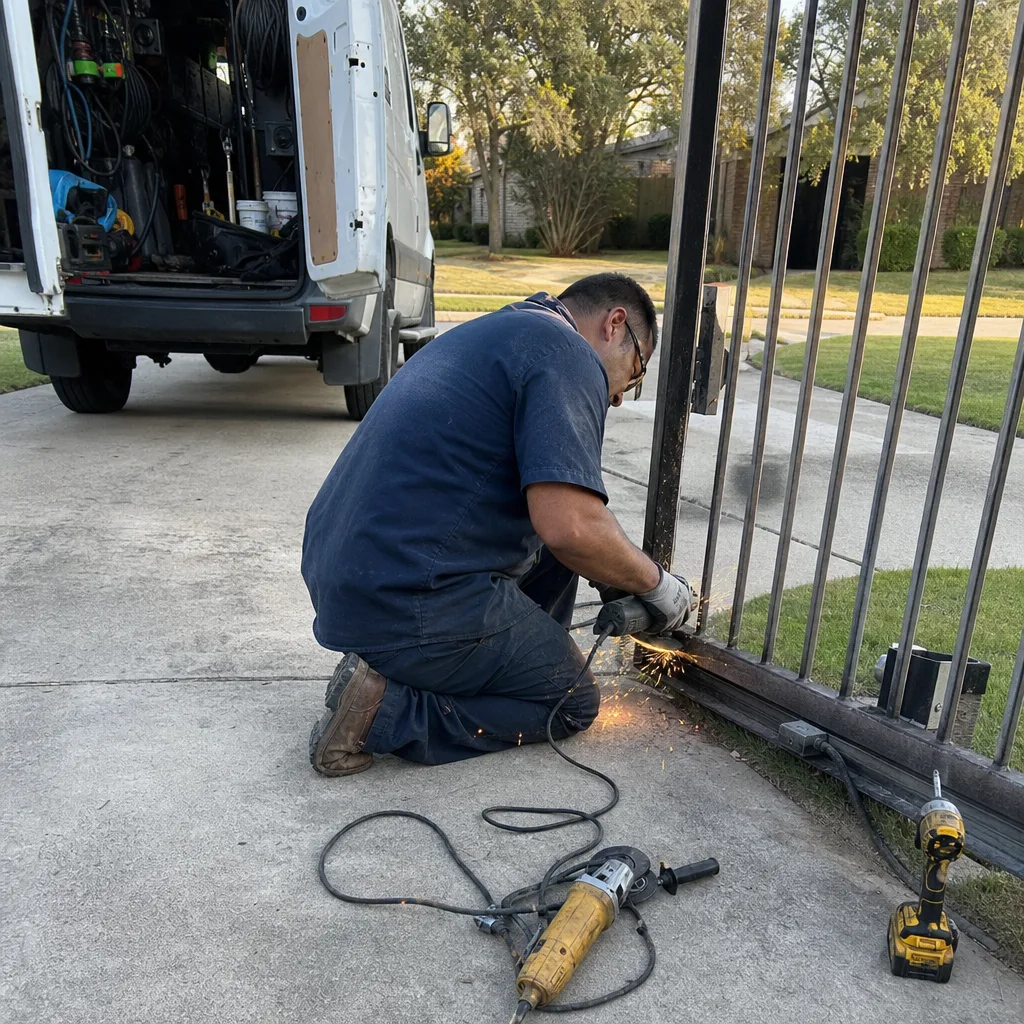
Homeowners in Spring are told to document storm damage for insurance purposes. Photograph the roof, photograph the fence, photograph the fence again from another angle. The gate is almost always treated as an afterthought, documented in a single wide shot if it’s documented at all. That’s a mistake. The gate is a structural element and an electrical system, and it’s exposed to everything the storm throws at it. If an insurance claim or a repair dispute arises, the photos you took the morning after the storm are your evidence.
Here’s what we recommend photographing after every major weather event in Spring:
- The control board with the cover open, showing the condition of the terminals, relays, and any visible moisture or corrosion. If a surge later kills the board, this photo is how you prove the storm caused the damage rather than normal wear.
- The photo-eyes from the front, showing any debris, damage, or misalignment. Photo-eyes get snapped off by wind-driven debris more often than people realise.
- The track or gate path showing debris, washout, or gravel that accumulated during the storm.
- The hinges and post from both sides, close enough to see if the gap has changed or if the post has shifted in its footing.
- The full gate from the driveway side and from the street side, enough to show overall alignment and any obvious tumbling or sagging.
Store the photos with a date stamp. The phone records the date automatically, but name the album something you’ll actually find later. “Gate storm pics” is fine. If you never need them, the cost was five minutes. If you do need them, you won’t be able to recreate them after the fact.
Our policy at Vance Gate Repair Spring is to leave a documented photo record of what we found, what we adjusted, and what we installed on every single visit. It’s the same documentation habit Adrian Vance developed doing commercial access-control work starting in 2014, applied to residential gates. Under Clause 4 of the Haven Standard, Evidence on every job, the photo log is part of the service, not an add-on. That record matters when a storm hit three weeks ago and the gate failed today and the insurance adjuster wants to know which event actually caused the damage.
The One Monthly Task: Photo-Eye Lenses in Pollen Season
The standard maintenance advice says clean photo-eye lenses once a year. In Spring, that’s wrong by a factor of twelve. From roughly March through May, and again in a lighter wave in early fall, Spring’s pollen load is heavy. Oak, pine, and cedar pollen settles on everything. On a photo-eye lens, it builds a fine yellow film that diffuses the infrared beam. The beam gets weaker. Eventually the gate’s safety system interprets the weak signal as an obstruction and refuses to close, or reverses mid-close for no visible reason.
Worse, morning dew wets the pollen, and the sun bakes the residue into a crust that doesn’t come off with a dry cloth. The gate starts behaving erratically. The homeowner resets the breaker, replaces the battery, blames the motor. The actual fix is thirty seconds with a lens wipe and some warm water.
Here’s the monthly routine for pollen season:
- Wipe each photo-eye lens with a dry microfiber cloth first. This removes loose pollen before you add any moisture.
- Dampen a corner of the cloth with warm water and wipe again. Don’t use glass cleaner or solvent. Some photo-eye lenses are plastic, and solvents cloud them permanently.
- Check the indicator light after cleaning. If the light is solid, the beam is aligned and clean. Let the gate run a full cycle to confirm.
- Repeat next month. During peak pollen, mark it on the calendar. The first of the month, the fifteenth, whatever day you’ll actually remember. Consistency matters more than the specific date.
This is the single highest-return maintenance task in Spring for the time invested. A photo-eye that’s clean and aligned prevents more nuisance service calls than any other ten-minute task. And when the beam is clean, the gate closes. When it’s not, the gate doesn’t. That’s the whole mechanism.
Cold-Snap Preparation: December Through February
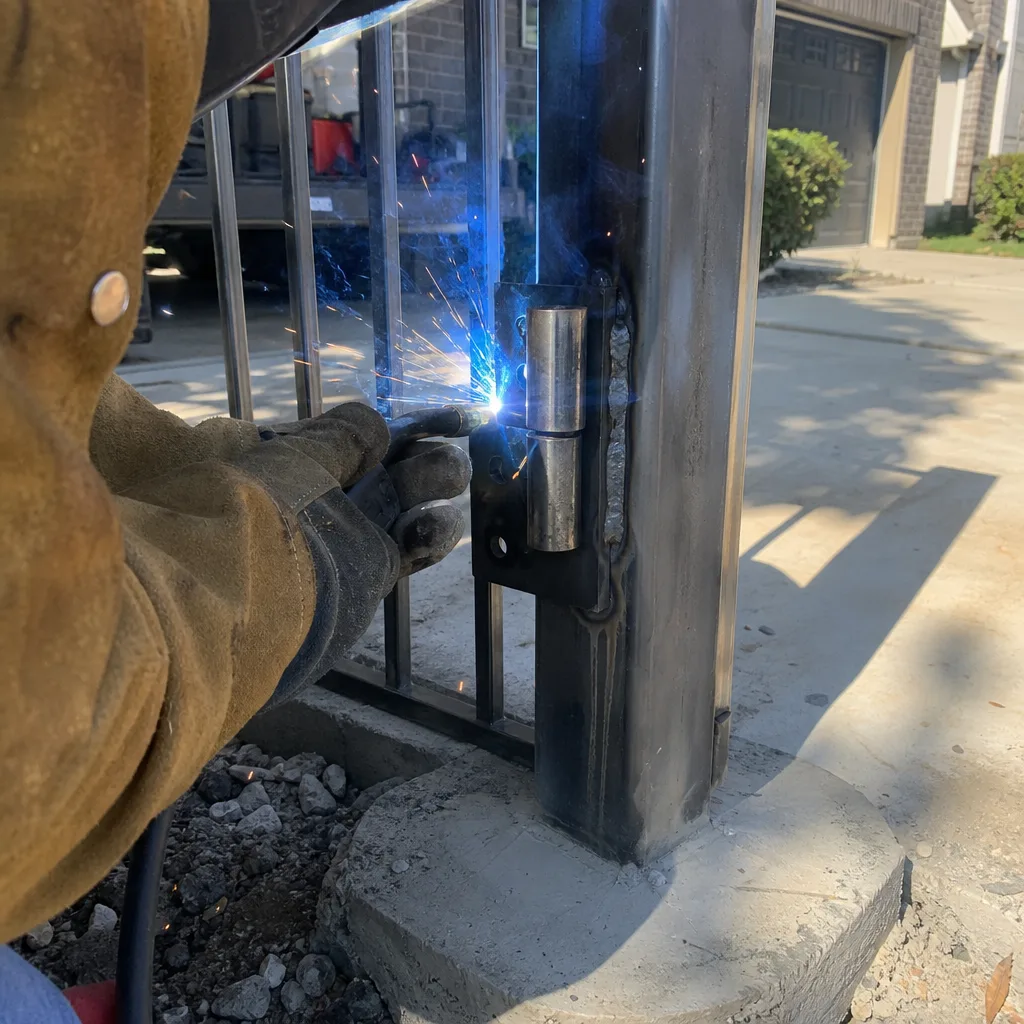
Spring’s freezes are rare, which makes them more dangerous to gate systems than sustained cold in northern climates would be. In a place where the temperature drops below freezing every winter, gate systems are built and maintained with cold tolerances in mind. In Spring, that’s not the case. The equipment on a Texas gate is selected for heat, not cold. When the temperature drops into the twenties for a night or two, two specific failure modes appear that we rarely see at any other time of year.
The first is hydraulic contraction. Hydraulic gate openers use fluid pressure to move the gate. When the temperature drops, the fluid thickens and contracts. A gate that worked fine in November moves sluggishly in a January freeze, or fails to complete its travel. The motor runs, but the pump can’t build enough pressure to move cold fluid through cold lines. Homeowners in Spring who experience a rare cold snap often assume the motor has failed. In most cases, the motor is fine and the system needs the fluid warmed or replaced with a grade that handles the occasional freeze.
The second is battery failure in cold. Gate systems with battery backup, and solar-powered gates, rely on battery chemistry that loses capacity sharply in cold temperatures. A battery that holds a full charge at 90 degrees may deliver half that capacity at 28 degrees. If the gate runs off battery at night or during a power outage, the cold reduces the available run time. The battery isn’t defective. It’s just cold. But if the freeze lasts long enough, the battery may not recover, and a replacement is needed.
Cold-snap preparation in Spring is straightforward:
- Check the hydraulic fluid level on hydraulic systems before the first forecast freeze. Low fluid plus cold temperatures is a double problem.
- Test the battery backup in December, not in February. A battery that’s already weak will fail permanently in a cold snap. Better to find out while the weather is still mild.
- Lubricate hinges and rollers with a cold-rated grease. Grease thickens in cold. The wrong grease turns a smooth hinge into a sticky one when temperatures drop.
- Clear the track or gate path of leaves and standing water. Ice forms in puddles. A roller that freezes into a puddle is a roller that tears out of the track when the gate opens.
We’ve repaired enough freeze-damaged gates in Spring to know the pattern: the damage is usually reversible if it’s caught in the first day or two. Left alone, a frozen roller or a starved hydraulic pump turns a $200 fix into a $1,200 replacement. The freeze may last one night. The repair bill lasts longer.
Common Mistakes to Avoid
- Ignoring a squeak because “it still works.” A squeak is metal on metal without lubrication. It’s not an annoyance. It’s a wear indicator. In Spring’s heat, an unlubricated hinge wears faster than in any other season because the metal is already expanded and rubbing harder.
- Resetting the breaker repeatedly. If the gate trips the breaker more than once, the breaker is doing its job. There’s a short or an overload somewhere. Resetting it again doesn’t fix the short. It invites a fire. Find the fault before you reset it a third time.
- Lubricating with WD-40. WD-40 is a water displacer, not a lubricant. It cleans and temporarily frees, then evaporates and leaves the metal drier than before. Use a purpose-made dry lubricant or a cold-rated grease for gate hinges and rollers.
- Painting over a rust spot without treating it. A rust spot on a gate frame in Spring’s humid climate keeps rusting underneath the paint. The visible rust is just the vent. Treat the rust with a converter or remove it mechanically before painting, or the bubble reappears within a season.
- Assuming the gate is grounded because it’s metal. A metal gate on metal posts is not the same as a proper electrical ground. Surge and lightning protection depends on the grounding arrangement at the control board and the motor. A gate without proper grounding survives a nearby lightning strike by luck, not by design.
- Postponing a small fix until after storm season. A loose hinge in May becomes a broken hinge in August. A worn roller in June becomes a derailed gate in September. The small fix is always cheaper before the storm than after it.
- Documenting damage but not the condition before the damage. Photos after the storm are useful. Photos from March, before the storm, are the baseline that proves what the storm actually changed. Take a set of baseline photos every spring and fall, then add the post-storm photos when the weather hits.
When to Call a Professional
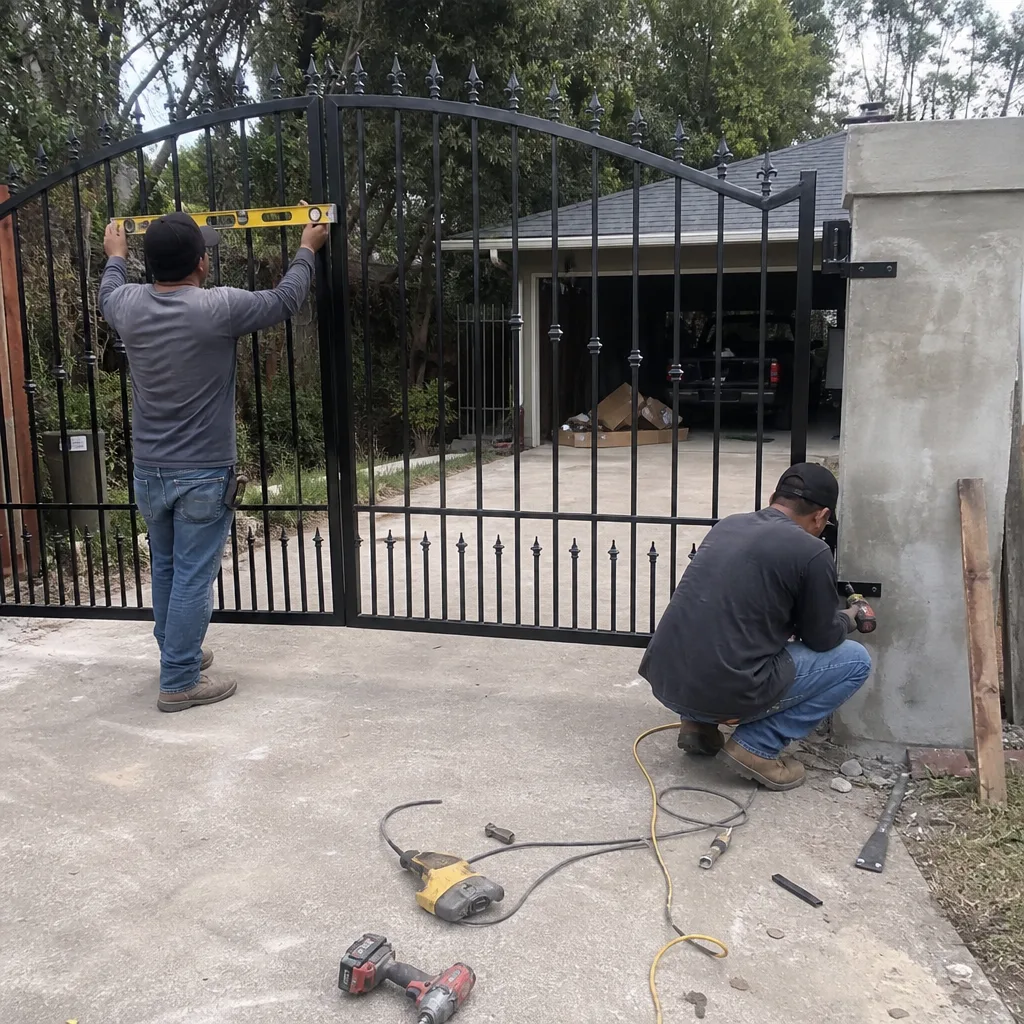
Most of the maintenance tasks in this guide are homeowner-level. A rag, a measuring tape, a phone camera, and some lubricant will handle the photo-eyes, the hinge gap check, and the documentation. But there are conditions where a trained technician is the right call. If the gate trips the breaker repeatedly, if the control board shows signs of scorching or melted terminals, if the gate has shifted in its footing or the post has become loose in concrete, if there’s any sign of water inside the control box, or if you’re not certain the gate is properly grounded, call someone who does this work professionally. Gates with high-tension components and line-voltage control boards can cause serious injury if something is misdiagnosed. Vance Gate Repair Spring offers free estimates in Spring, and the written price is delivered before any work starts. Call (346) 488-1637 and a live person answers, any hour.
Frequently Asked Questions
A seasonal inspection and tune-up of a residential swing or slide gate in Spring typically runs between $120 and $350, depending on the gate type, the motor brand, and whether any parts need replacing. A simple photo-eye cleaning and hinge lubrication is at the low end. An inspection that includes adjusting limit switches, testing the battery backup, and replacing a gasket is at the higher end. Vance Gate Repair Spring prices the work in writing before starting, so there’s no surprise on the invoice. Call (346) 488-1637 for a free estimate.
Most gate failures that are not parts-related, things like a misaligned photo-eye, a tripped limit switch, or a bound hinge, can be diagnosed and often repaired the same day. Parts-dependent repairs, like a replacement motor board or a new hinge set, depend on parts availability. We stock common components for the brands we service, including LiftMaster, FAAC, BFT, and Mighty Mule, but a specific board for an older model may need to be ordered. We’ll tell you the expected timeline in writing before any work begins.
A full Gate Installation in Spring includes the gate fabric, posts and hinges, the motor or opener, the control board, photo-eyes and safety edges, wiring, and typically a battery backup if the customer wants one. We handle the power run and the safety edges as part of the scope, and the price is written and agreed before any work starts. Installation work is measured, ordered, and scheduled; it’s not same-day work, but we’ll give you a free measure and a written price.
Yes. The power run from the electrical supply to the control box, and the installation of the photo-eyes and safety edges, are part of the installation scope when we install a gate. If you’re adding automation to an existing manual gate, we’ll run the power and install the safety systems as part of that job. Every installation leaves a documented record of what was wired, what was set, and what was installed.
The most common cause in Spring is water intrusion into the photo-eye or the control box. When rain gets into a photo-eye housing, it puts water on the lens or on the circuit board and the beam fails, which the safety system reads as an obstruction. When rain gets into the control box, it can cause a short that trips the board. Both are repairable, but the leak path needs to be found and sealed or the problem returns with every storm. Call (346) 488-1637 and we’ll figure out where the water is getting in.
Early to mid-March is ideal. That’s when the weather is still mild and before the pollen load and the first afternoon thunderstorms arrive. The pre-summer checklist, hinge gap measurement, enclosure seal inspection, limit switch travel check, and battery test, takes priority before the heat arrives. By April, the technician’s schedule fills up with storm-related calls and the heat makes the work slower. If you want a Gate Motor & Opener in Spring evaluation before summer, do it in March.
The Bottom Line
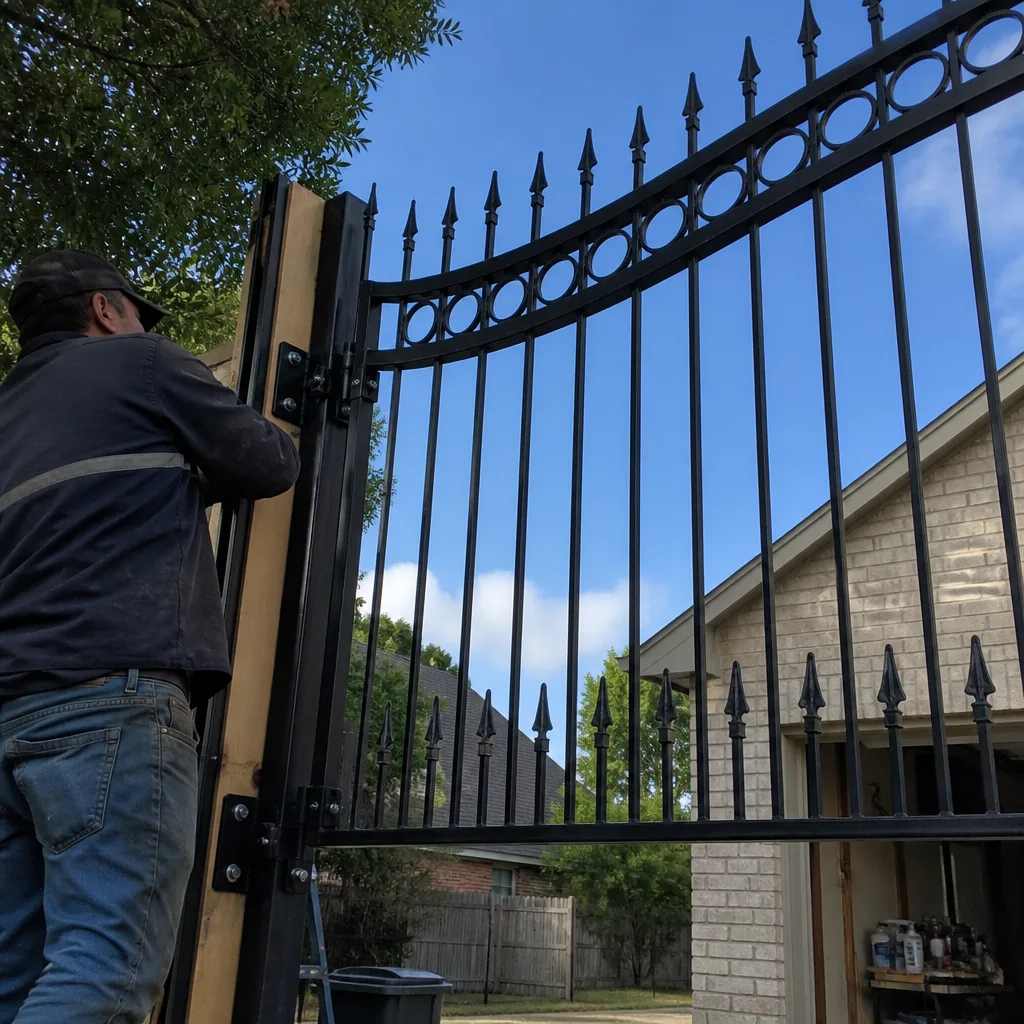
Gate care in Spring is not about a generic maintenance schedule from a national checklist. It’s about matching your attention to the actual weather pattern: thermal checks before the heat, storm inspections within 48 hours of severe weather, monthly photo-eye cleaning during pollen season, and cold-snap preparation before the rare freezes. The difference between a $100 adjustment and a $1,200 replacement is often just a matter of when the problem is found. Document what you see with your phone, pay attention to changes in how the gate sounds and moves, and when a problem is beyond what you can see or safely fix, call a professional who will put the price in writing before any work starts.
Written by Adrian Vance, Owner at Vance Gate Repair Spring home, serving Spring since 2014.